Late-night battles, team fights reaching their climax—your fingers fly across the keys when suddenly the keyboard flashes red, the signal drops, your character freezes in place, and the team fight collapses. This isn't a skill issue; it's the battery failing at the critical moment. Countless gamers and office workers have experienced this: a wireless keyboard's battery life seems fine out of the box, but after six months, it noticeably degrades. It's fully charged, yet after just two days, the low-battery warning appears. Turn on the RGB lighting, and the power drains even faster. On social media, complaints like "battery life is too short," "charges for ten hours, lasts only a few," and "the battery doesn't hold up" are everywhere.
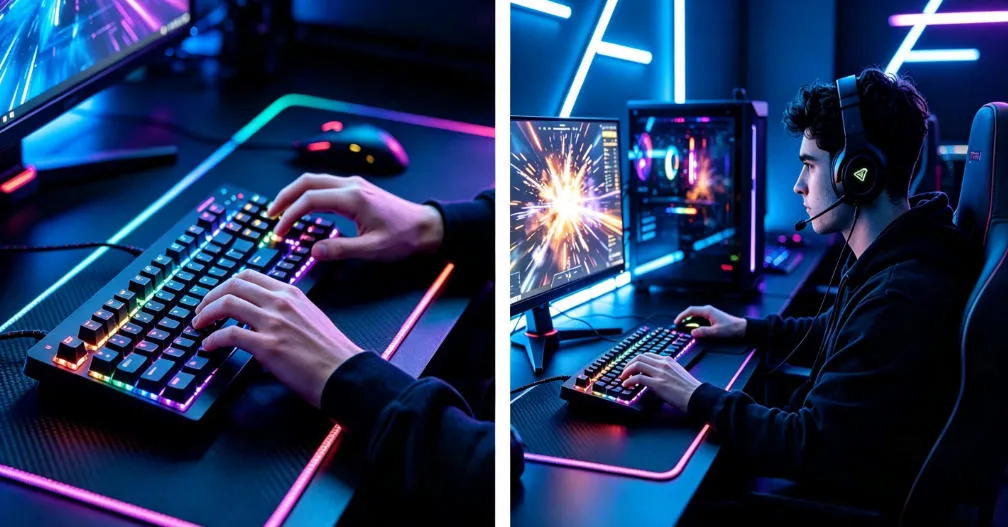
The keyboard, as the core input device for human-computer interaction, operates on a straightforward principle: each keystroke triggers a switch signal, the main control chip encodes the signal and transmits it to the computer via Bluetooth or a 2.4G wireless module, while simultaneously driving the RGB lighting system to create an immersive atmosphere. However, this continuous operation of "signal transmission + lighting rendering" makes the keyboard a veritable "power consumption beast." Whether it's the decisive operations of a professional eSports player, a programmer's late-night coding session, or a content creator's burst of inspiration—whether this "fingertip chariot" can hold up at the critical moment often depends on the power source hidden inside the battery compartment.
In recent years, with the booming development of the eSports industry, the widespread adoption of remote work models, and the maturation of wireless transmission technology, wireless keyboards have evolved from "office aids" to "competitive essentials." In eSports scenarios, they free players from cable constraints for more fluid control. In office settings, they create a cleaner desk and more efficient workflow. In content creation, they allow creators to capture inspiration anywhere, anytime. The keyboard is no longer just an input tool; it is becoming critical equipment for improving work efficiency and competitive gaming performance.
In this context, the battery is not just a source of energy but the core of device stability and user experience. The industry's focus is not on how many switch types or lighting effects a keyboard has, but on whether it can continuously and stably respond to every keystroke at the critical moment—can the battery provide stable power without sudden disconnection when an eSports player is executing decisive moves? Can the battery support a full day of focused work without giving out halfway when a programmer codes for hours on end? When a keyboard is frequently carried between home and the office, can the battery withstand bumps and vibrations without causing poor contact?
Real user feedback includes complaints like "runs out of power in two or three days," "charges for over ten hours but only lasts a few," and "battery life drops significantly after a year." This has directly driven keyboard batteries to evolve from "ordinary disposable batteries" toward "high-capacity rechargeable, long cycle life, low self-discharge, and stable power supply." Therefore, in keyboards—a device directly tied to work efficiency and gaming experience—battery capacity, cycle life, discharge stability, and safety reliability have become the core factors determining whether a product can truly win user trust and stand out in the fiercely competitive peripheral market.
Although keyboards are not large devices, their operating logic and usage scenarios impose far more complex and stringent design requirements on batteries than ordinary portable electronics:
Consistent and Stable Power Supply: Wireless keyboards need to continuously power the wireless module and main control chip. When RGB lighting is activated, power consumption increases exponentially. The battery must provide a stable discharge platform to avoid voltage fluctuations that could cause unstable wireless signals, key input lag, or even disconnection.
Low Self-Discharge and Long Standby Performance: Keyboards are not in continuous use; they have significant idle periods. The battery must feature excellent low self-discharge characteristics so that even after weeks of inactivity, it retains ample charge and does not require emergency charging or replacement.
Long Cycle Life for High-Frequency Use: Keyboards are high-frequency-use devices, especially for gamers and heavy office users who operate them for hours daily, resulting in frequent charging. Ordinary batteries see significant capacity degradation after just 200–300 cycles. The battery must possess excellent cycle life to ensure the long-term user experience remains uncompromised.
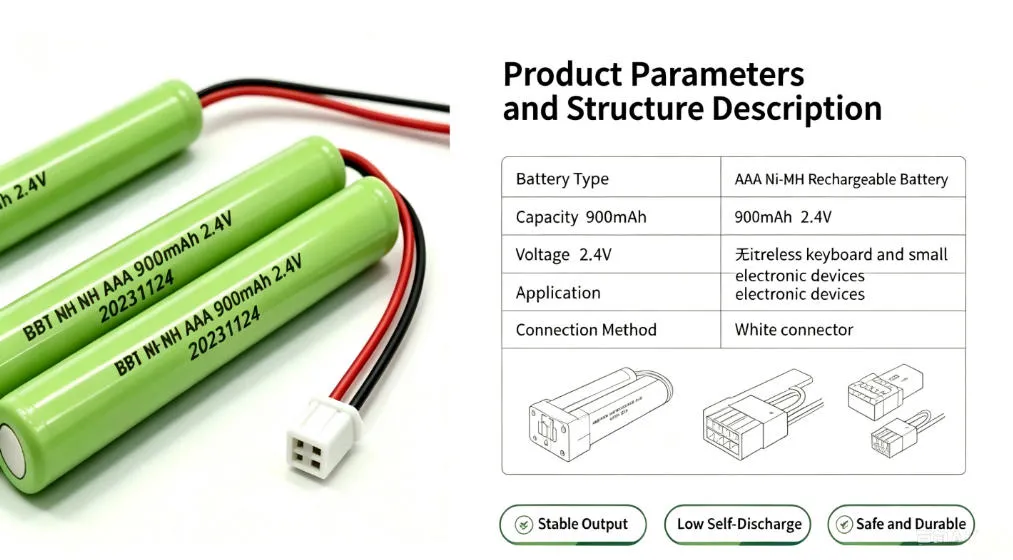
Balance of Lightweight and Compact Dimensions: Keyboards pursue slim, portable designs with limited battery compartment space. The battery must achieve a reliable 900mAh capacity within the compact dimensions of MAX 12.2 × 10.5 × 88 mm while remaining lightweight, without affecting the keyboard's overall weight and feel.
Adaptability to High and Low Temperature Environments: Keyboards may be left in hot cars during summer or cold environments during winter. Ordinary batteries suffer reduced discharge capacity in low temperatures and accelerated aging in high heat. The battery must support stable operation across a wide temperature range.
Vibration Resistance and Safety for Mobile Scenarios: Keyboards are frequently transported and inevitably subjected to shaking and impacts. The internal structure of the battery pack must be robust, with secure solder joints to eliminate contact failures or open circuits caused by vibration. At the same time, overcharge, over-discharge, overheat, and short-circuit protections are indispensable.
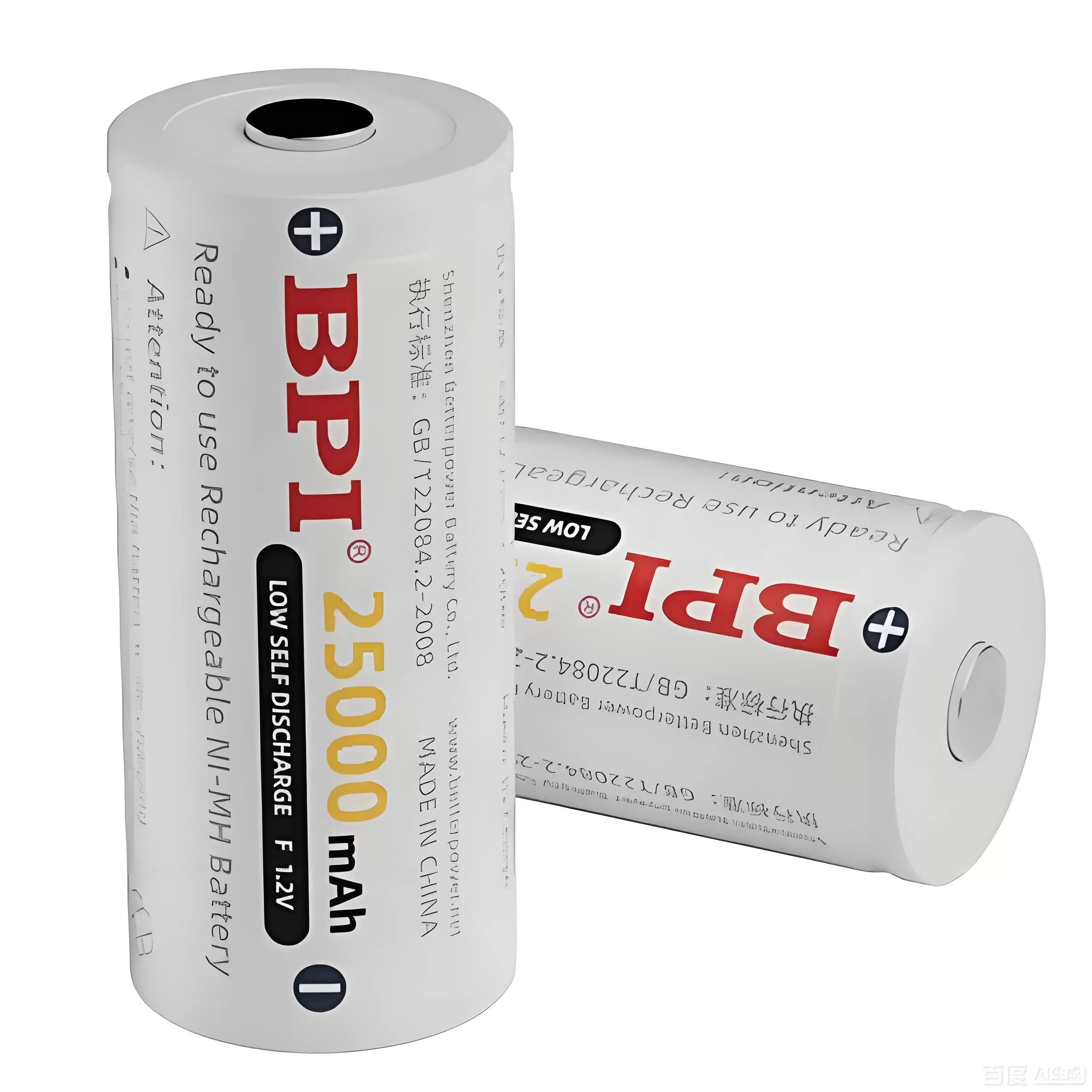
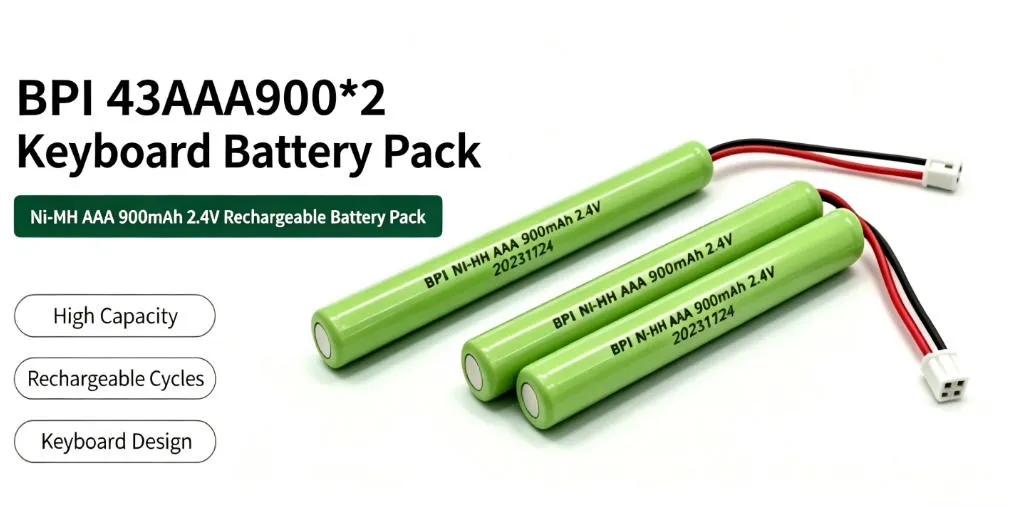
Among various battery technologies, high-performance nickel-metal hydride (Ni-MH) rechargeable batteries have become the classic power solution for wireless keyboards thanks to their comprehensive performance advantages. Compared to built-in lithium battery solutions, Ni-MH batteries offer unique benefits such as replaceability, no memory effect, low self-discharge, and environmental recyclability. Taking the BPI 43AAA900*2 + plug Ni-MH battery pack (2.4V / 900mAh, 2S1P) as an example—it uses two AAA (Size 7) 900mAh Ni-MH cells in series, achieving a 2.4V voltage platform and 900mAh reliable capacity within the compact dimensions of MAX 12.2 × 10.5 × 88 mm, perfectly meeting the keyboard's dual demands for long battery life and stable power supply:
| Core Requirement | Ni-MH Battery Solution |
| Long-Lasting Battery Life | Utilizes a high-capacity Ni-MH material system with a single-cell capacity of 900mAh. The BPI 43AAA900\*2 combination provides 2.4V / 900mAh, meeting the keyboard's power needs for weeks or even months. |
| Stable Power Supply | Ni-MH batteries feature a stable discharge plateau with gradual voltage drop, ensuring the wireless module and main control chip receive stable power and eliminating signal disconnections and input lag. |
| Low Self-Discharge | Employs low self-discharge technology, retaining over 70% charge after six months of storage. Even after the keyboard sits idle for weeks, the battery remains fully capable. |
| Long Cycle Life | Premium Ni-MH cells maintain over 80% capacity retention after 500 deep charge/discharge cycles. Calculated at one charge per week, this equals nearly 10 years of use. |
| Replaceable Design | Unlike traditional built-in lithium batteries, Ni-MH batteries can be swapped out at any time. When depleted, simply replace the batteries in one minute and resume use—no waiting for charging. |
| No Memory Effect | Ni-MH batteries have no memory effect and do not require full discharge before recharging, making usage more convenient. |
More importantly, they deliver reliability and safety directly serving high-frequency usage scenarios. Ni-MH batteries do not catch fire or explode under abnormal conditions such as overcharge, over-discharge, or short circuit, offering inherently higher safety. Additionally, Ni-MH batteries contain no harmful heavy metals such as cadmium or lead, comply with RoHS environmental requirements, and are recyclable. Combined with a precision plug connection solution, they ensure stable and reliable electrical contact between the battery pack and the keyboard, making every keystroke respond with precision.
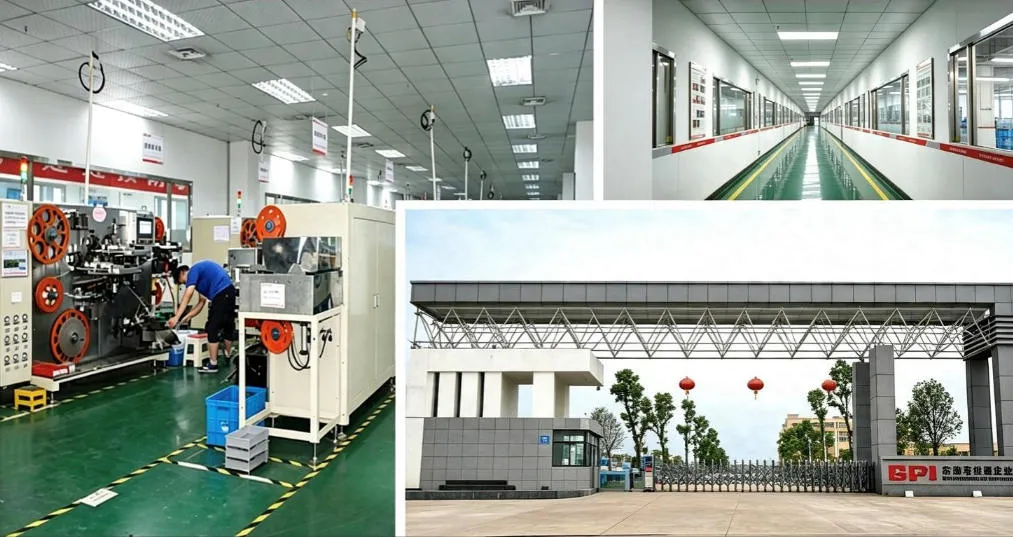
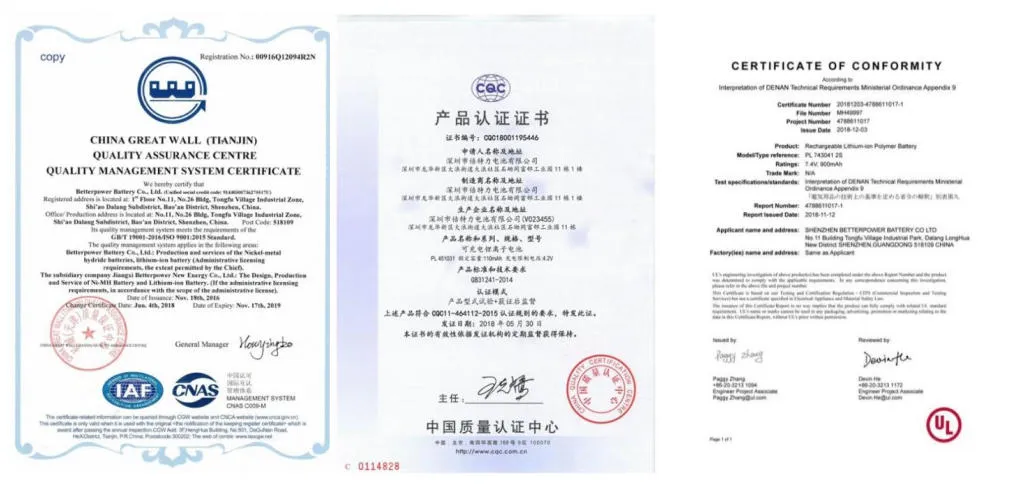
As a manufacturing enterprise with 24 years of deep engagement in the battery industry, BPI has developed a complete and mature product system in the Ni-MH battery field and has accumulated extensive experience in peripherals, consumer electronics, and other fields with extremely high reliability requirements. Founded in 2002 and headquartered in Shenzhen, BPI operates two major production bases in Shenzhen Longhua and Jiangxi Yichun, covering a total area of over 200 mu with more than 1,500 employees. In 2023, the Jiangxi BPI New Energy Phase III fully automated factory was put into operation, with a daily Ni-MH battery production capacity exceeding 500,000 units. The company has been successively rated as a national high-tech enterprise and a national-level "Little Giant" specialized and innovative enterprise. Its products have passed international certifications including UN38.3, UL, CE, RoHS, REACH, and KC, and are exported to over 80 countries and regions worldwide. The company holds more than 200 national patents, covering core fields such as high-capacity Ni-MH batteries, low self-discharge technology, and battery pack structural design.
Equip keyboard devices with BPI dedicated batteries to extend device usage time and improve operational stability. The batteries undergo rigorous environmental testing and performance validation, with quality trusted by customers in the entertainment and imaging industries. Addressing the three core needs of keyboards—"continuous stable power supply," "low self-discharge for long standby," and "long cycle life for high-frequency use"—BPI has launched the 43AAA900*2 + plug Ni-MH battery pack (2.4V / 900mAh, 2S1P). It uses two high-quality AAA 900mAh Ni-MH cells in series, achieving large-capacity energy storage within the compact dimensions of MAX 12.2 × 10.5 × 88 mm, providing abundant power for wireless keyboards.
At the product design stage, BPI is application-scenario-oriented: for the high-frequency charge/discharge characteristics of keyboards, high-consistency Grade-A cells are selected to ensure over 80% capacity retention after 500 cycles. For the low-power, long-standby characteristics of keyboards, low self-discharge technology is adopted to retain over 70% charge after six months of storage. For the bump and vibration scenarios of mobile transportation, a precision plug connection solution and enhanced encapsulation process are employed to significantly improve the battery pack's shock and impact resistance. For safety requirements, built-in protection designs provide multiple safeguards against overcharge, over-discharge, and overcurrent. The BPI 43AAA900*2 battery pack, with its outstanding performance of high capacity, long cycle life, low self-discharge, and inherent safety, provides a trustworthy power guarantee for wireless keyboards.
1. Misconception 1: Blindly Pursuing Built-in High-Capacity Lithium Batteries while ignoring the convenience of replaceability. Many keyboard manufacturers are keen to promote the "ultra-long battery life" of built-in high-capacity lithium batteries, but the real user experience is often "runs out of power in two or three days." More critically, once a built-in lithium battery degrades, the keyboard is essentially "scrapped" or requires a complex disassembly and replacement process. In contrast, Ni-MH batteries can be replaced at any time. When depleted, simply swap in new batteries in one minute and resume use—a convenience that rechargeable keyboards simply cannot match.
2. Misconception 2: Ignoring Low Self-Discharge Performance and Standby Power Consumption. The usage pattern of keyboards is characterized by both "high-frequency, short-duration" use and "long-term standby." If the battery's self-discharge rate is high, after weeks of idle time, the charge will be depleted, forcing the user to urgently replace the battery or plug in to charge. High-quality Ni-MH batteries must possess excellent low self-discharge characteristics to ensure the keyboard is ready to use whenever it is picked up.
3. Misconception 3: Underestimating Cycle Life and Long-Term Reliability. Keyboards are high-frequency-use devices, especially for gamers and heavy office users who use them almost daily. Batteries that have not undergone rigorous cycle life validation will see significant capacity degradation after one year of use. The BPI 43AAA900*2 offers 500 cycles under IEC standard testing. Calculated at one charge per week, this equals nearly 10 years of use—far exceeding the lifespan standards of ordinary batteries.
4. Misconception 4: Insufficient Structural Protection, Ignoring Vibration and Impact in Mobile Scenarios. Keyboards are frequently carried between home, the office, and eSports venues, inevitably subjected to shaking and bumps. Battery packs without targeted structural reinforcement are highly prone to poor contact and loose plugs during frequent transportation, which can cause intermittent disconnections at best and severely compromise the overall user experience at worst.
Keyboard and battery, fingertip competition and power source—the two are inseparable. No matter how responsive the mechanical switches or how dazzling the lighting effects, if the battery cannot deliver stable power, every critical keystroke may turn into regret.
BPI never compromises. From cell selection to battery pack encapsulation, from low self-discharge technology to factory testing, every battery is refined to stringent standards. The 43AAA900*2 battery pack ensures continuous wireless module operation with its stable 2.4V voltage, supports weeks or even months of lasting battery life with its 900mAh capacity, accompanies the keyboard reliably through years of use with its 500 long cycles, and offers a replaceable design that brings it back to full power in one minute when depleted. More precious than the specifications is BPI's unwavering commitment to quality over more than two decades—full-process traceability, batch-by-batch verification.
We deliver not just batteries, but the confidence behind every keystroke.
BPI 43AAA900*2 Keyboard Battery Pack—Replaceable, Long-Cycle, More Assured.
Q: How long can the 43AAA900*2 + plug battery actually last in use?
A: Calculated based on a typical wireless keyboard usage scenario (8 hours of daily use, RGB lighting off), the 2.4V / 900mAh capacity can support weeks to months of battery life (depending on the keyboard's power consumption). Battery life will shorten accordingly when RGB lighting is turned on. BPI uses high-quality Ni-MH cells with a stable discharge plateau, ensuring ample battery life for every use session.
Q: Do Ni-MH batteries have a memory effect? Do they need to be fully discharged before recharging?
A: BPI Ni-MH batteries employ advanced technology with no memory effect. They can be recharged at any time without requiring full discharge, making usage more convenient. Charging as needed does not affect battery life.
Q: What does 500 cycles of battery life actually mean in real-world use?
A: Calculated at one charge/discharge cycle per week, 500 cycles equate to nearly 10 years of normal usage. BPI strictly follows IEC testing standards, with capacity retention still ≥80% after 500 cycles. Even after many years of use, the battery can maintain over 80% of its original battery life.
Q: Will the battery be depleted after long-term idle storage?
A: The BPI 43AAA900*2 employs low self-discharge technology, retaining over 70% charge after six months of storage. Even if the keyboard sits idle for several weeks, the battery remains fully capable upon next use, with no need for emergency charging or replacement.
Q: Is the battery safe? Is there a risk of leakage?
A: Ni-MH batteries offer inherently high safety and will not catch fire or explode under abnormal conditions such as overcharge, over-discharge, or short circuit. BPI batteries undergo rigorous environmental testing and performance validation, with reliable quality that eliminates leakage risks. The products comply with RoHS environmental requirements and are recyclable.