Security surveillance equipment is a comprehensive electronic system hardware cluster with video detection technology at its core and safety protection as its ultimate goal. It integrates functional modules including image acquisition, data transmission, intelligent processing, and local/cloud storage, enabling uninterrupted visual monitoring, abnormal behavior recording, and proactive risk alerting for protected areas. Relying on optical imaging components, high-sensitivity image sensors, embedded intelligent analysis algorithms, and multi-mode wireless communication technology, this system can replace or assist human manpower to conduct 24-hour on-site image acquisition and transmission back under harsh conditions such as nighttime, rain and fog, high temperatures, or severe cold where manual long-term stationing is difficult. Whether in family courtyards, street-facing shops, industrial parks, transportation hubs, or remote infrastructure construction sites, security surveillance equipment silently plays the role of a "never-tiring electronic patrol officer"—allowing managers to both "see" real-time dynamics, "store" historical footage, and "find" evidence at critical nodes, truly achieving post-event traceability and pre-event early warning.
In the security surveillance field, the true test often lies not in temperature-controlled indoor environments but on rooftops scorched by blazing sun,郊外 battered by rain and snow, and uninhabited areas with extreme day-night temperature differentials. When monitoring equipment is entrusted with the mission of a "24-hour electronic sentry," a battery capable of withstanding extreme environments becomes its most solid "energy shield."
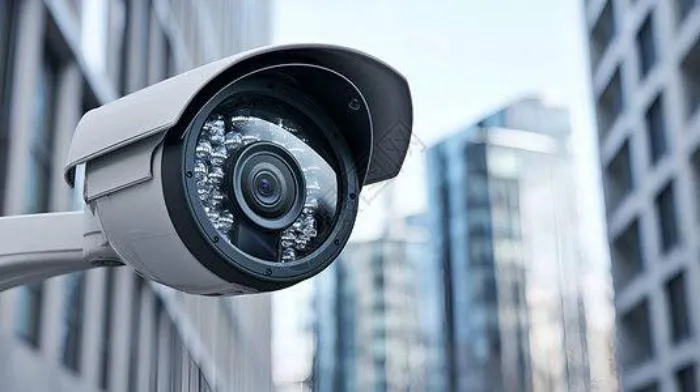
The maturation of IoT technology, the awakening of public safety awareness, and the deployment of low-power wireless communication and solar charging solutions have allowed security surveillance to break free from cable shackles, truly achieving the freedom to "install wherever desired." Beneath power transmission towers, beside remote mountain base stations, in family courtyards, and at temporary construction sites—wireless monitoring is everywhere. It is no longer merely a cold recording device but a "thousand-mile eye" and "night watchman" guarding property safety and watching over family well-being.
However, when cameras break free from socket constraints, a more thorny problem surfaces: who can provide them with persistent, reliable, weather-defying power support?
Reality is far more complex than imagination. When a device is mounted on a 3-meter-high utility pole, no one wants to carry a ladder every month to replace the battery. When the southern plum rain season brings half a month without sunlight, rendering solar panels useless, can the battery survive this "darkest hour"? When northern winters freeze water droplets into ice and southern summers turn ground surfaces scorching hot, ordinary batteries either "freeze into dormancy" or "strike from the heat."
Endurance anxiety has never been more real.
Precisely for this reason, the evolution logic of security surveillance batteries has been completely reshaped. It no longer settles for "good enough" consumer-grade standards but sprints with full force toward greater capacity, longer life, more extreme environment endurance, and higher protection ratings. On the uncompromising battlefield of security surveillance, battery quality directly draws a watershed: on one side are low-end products with frequent power outages and endless user complaints; on the other side are high-quality choices that remain online year-round and provide complete peace of mind.
On the surface, a wireless monitor's power consumption is far lower than that of a mobile phone or tablet, suggesting that battery requirements are "roughly similar." However, when we turn our gaze to real installation and usage scenarios, we discover that security surveillance is far more demanding than the vast majority of consumer electronics. It is not a digital device working quietly on a desk but a "lone brave warrior" silently standing guard under eaves, atop utility poles, and on remote mountain towers.
Wireless monitors spend over 95% of their time in "light sleep" power-saving mode, conserving every milliampere-hour for the most critical moments. But once a PIR sensor captures a flicker of human movement, or a user on the other side of the globe clicks "live view," the device must wake up at full speed within milliseconds, instantly maxing out Wi-Fi or 4G transmission power to push the on-site footage to the screen in one seamless stream. What does this mean for the battery? On one side is microampere-level low self-discharge, supporting months or even half a year of long standby; on the other side is multi-ampere pulse large current that must be "on call" without hesitation at the trigger moment. These two diametrically opposed characteristics must coexist perfectly in the same battery—this is the first threshold that ordinary cells struggle to cross.
The constant temperature and humidity enjoyed by indoor electronic products is a luxury for outdoor monitoring. On northern winter nights at -20°C, ordinary batteries experience surging internal resistance and voltage drops, potentially causing cameras to "play dead" on the very mornings when they are most needed. Under southern midsummer sun exposure, device casing temperatures easily exceed 60°C, exposing ordinary batteries to thermal runaway risks and cliff-like lifespan degradation. What BPI must achieve is allowing batteries to travel calmly between these two "forbidden zones," with power output always online regardless of environmental changes.
Rainwater splashing from beneath eaves, sea winds carrying salt spray at the coast, and dust flying everywhere at mining sites—these environments that are virtually "chronic poison" to electronic products are precisely the daily reality of outdoor monitoring. As the "energy warehouse" of the complete device, the battery pack's casing sealing and interface protection must not become the weakest link in the entire machine's waterproof chain. Once moisture or dust intrudes, the best-case scenario is short-circuit failure; the worst-case scenario triggers safety hazards. IP65-level protection is not a bonus item but an entry ticket.
Whether paired with solar panels "living off the weather" or removed by users for charging every few months, surveillance batteries must face the "physical depletion" of repeated charge/discharge cycles. Three hundred deep cycles mean that within the 3–5 year device service life, battery capacity cannot experience cliff-like degradation—otherwise, mid-shooting power outage at night or alarm failure to upload during rainy days renders even the highest-definition camera useless. Long cycle life is not for making parameters look good but to prevent users from one day suddenly discovering: the monitor has "gone mute."
Among various battery technology routes, high-performance lithium-ion batteries have become the mainstream power solution for security surveillance by virtue of their comprehensive performance advantages. The reason is that they perfectly align with the core requirements of security surveillance:
| Core Requirement | Lithium Battery Solution |
| Ultra-Long Endurance | Utilizes a high energy density material system to provide up to 10,000 mAh large capacity within compact monitor casings, supporting months of standby and hundreds of wake-up captures. |
| Instantaneous Burst Power | Supports 3C continuous discharge, easily addressing the instantaneous large-current demand when surveillance devices wake up for image transmission, ensuring stable and stutter-free video transmission. |
| Long Cycle Life | Quality power cells maintain favorable capacity retention after 300 deep charge/discharge cycles, extending overall device service life. |
| Intelligent BMS Management | Cooperates with an intelligent Battery Management System (BMS) to achieve precise voltage, current, and temperature monitoring, providing multi-layer protection against overcharge, over-discharge, overcurrent, and short circuit. |
More importantly, intrinsic safety for outdoor use. Since August 2023, China has formally implemented CCC certification management for lithium-ion batteries, further safeguarding mandatory battery safety. Through built-in protection circuit modules (PCM) and thermistors (NTC), circuits can be instantaneously cut off when encountering abnormal heating, external short circuit, or overcharge/over-discharge, ensuring both device and personal safety.
As a manufacturing enterprise with years of deep expertise in the battery industry, BPI has developed a complete and mature product system in the lithium battery field and accumulated extensive experience in fields with extremely high reliability requirements such as intelligent security and medical equipment.
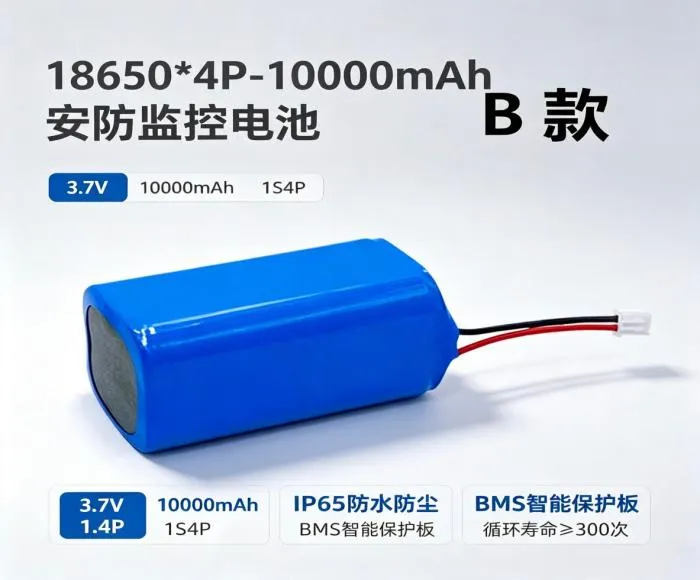
BPI's 18650×4P-10,000 mAh battery pack, specifically built for outdoor security scenarios, redefines the power standard for wireless monitoring with three core characteristics: low self-discharge, large capacity, resistance to high and low temperatures, and long cycle life.
Wireless security surveillance spends most of its time in standby hibernation, imposing extremely stringent requirements on battery self-discharge rates. BPI adopts high-stability electrode materials and low self-discharge electrolyte formulations, controlling the battery's monthly self-discharge rate at room temperature to an extremely low level. Paired with the ultra-large 10,000 mAh capacity design (1S4P parallel architecture, nominal voltage 3.7V), it can support surveillance devices for months of continuous standby and hundreds of wake-up captures even in pure battery-powered mode without solar charging.
Whether in family courtyards or remote construction sites, users need not frequently disassemble and recharge, truly achieving a worry-free experience of "install and forget, reliable when needed."
Outdoor monitoring installation environments vary greatly—northern winter -20°C severe cold may cause ordinary batteries to "freeze" and fail; under southern summer sun exposure, casing temperatures easily exceed 60°C, exposing ordinary batteries to thermal runaway and sudden lifespan reduction risks.
BPI has conducted wide-temperature formulation optimization to address this pain point. Through specially doped cathode materials and low-viscosity temperature-resistant electrolyte, the battery maintains considerable discharge capacity in -20°C low-temperature environments, ensuring surveillance devices wake up normally on cold winter mornings. Under 60°C high-temperature operating conditions, the internal chemical system remains stable and controllable, paired with efficient heat dissipation structural design, effectively preventing overheating from eroding cycle life. Whether under blazing sun or amidst wind and snow, BPI battery packs consistently provide stable and reliable power output for monitoring devices.
Security surveillance equipment is typically designed for a service life of 3–5 years. As a consumable component, battery cycle life directly determines the overall machine's maintenance costs and user experience. BPI 18650 cells, under IEC standards, maintain excellent capacity retention after 300 deep charge/discharge cycles. This means that during the normal usage cycle, users need not worry about frequent device disconnections or interrupted nighttime shooting caused by cliff-like battery capacity degradation.
Paired with built-in intelligent protection boards (PCM), every battery pack undergoes rigorous full-process testing of voltage, internal resistance, capacity, and airtightness (initial internal resistance ≤ 85 mΩ), ensuring batch product consistency and long-term reliability. From cell grading to finished product factory delivery, the full process is traceable and controllable.
In addition to outstanding electrochemical performance, this battery pack's external structure is equally capable of withstanding challenges. A high-strength engineering plastic casing paired with precision sealing processes achieves IP65 waterproof and dustproof standards—completely dust-tight and protected against water jets, calmly handling coastal salt spray, mountain rainstorms, and mining dust in harsh environments. The compact dimensional design (66 × 77 × 19 mm) allows it to easily adapt to various security camera handle cavities and casing spaces without adding to the overall machine design burden.
In summary: BPI security surveillance battery—guarding persistent standby with low self-discharge, conquering extreme climates with wide-temperature formulations, reducing O&M costs with long cycle life, and facing outdoor wind and rain with IP65 protection. Choose BPI, and give every security camera, outdoor monitor, and wireless surveillance device an indestructible "energy shield."
1. Misconception One: Neglecting Wide-Temperature Operating Requirements. Ordinary digital cells are primarily designed for room-temperature environments. When applied to outdoor monitoring, when northern winter temperatures drop below freezing, battery capacity degrades severely or the battery cannot discharge at all; when summer sun exposure raises temperatures, it may trigger severe cell heating and sudden lifespan degradation.
2. Misconception Two: Insufficient Structural Protection, Ignoring the Destructive Force of Outdoor Environments. Outdoor monitoring is long-term exposed to wind, rain, dust, and salt spray. Battery packs without IP65-level protection design and airtightness testing are highly susceptible to internal short circuits caused by moisture infiltration. At best, this causes product failure; at worst, it triggers safety hazards.
In advanced intelligent security equipment, the truly critical components are often not the most dazzling. This holds true for security surveillance, and equally so for the power batteries inside them.
It is through large capacity, long cycle life, wide-temperature operation, IP65 protection, and intrinsically safe performance that BPI's 18650×4P-10,000 mAh battery pack continuously delivers value in these "invisible yet experience- and safety-critical" core positions. They not only provide persistent, stable power support for surveillance devices but also, through stringent quality control and full-process testing, ensure that devices remain rock-solid after years of outdoor guard duty, making human-technology interaction more reassuring and reliable.
In intelligent security applications, the battery is never a simple energy storage component but a core element of the entire device's safety and reliability system. BPI consistently adheres to strict standards as the fundamental criterion for product development and manufacturing, with full-process traceability and control. Over the product's multi-year usage cycle, performance changes are predictable, risks are controllable, and quality is assured.
For security surveillance batteries, choose safety, choose reliability, choose BPI!
Q: Does BPI's security surveillance battery pack support operation in outdoor low-temperature environments?
A: Yes. Our 18650×4P-10,000 mAh battery pack adopts a wide-temperature formulation design, capable of stable operation within the temperature range of -20°C to 60°C, calmly handling extreme outdoor scenarios including northern winter severe cold and southern summer sun exposure.
Q: How is the battery pack's IP65 waterproof and dustproof rating achieved?
A: The battery pack casing adopts high-strength engineering plastic with precision sealing processes, with waterproof treatment at interfaces, achieving an overall IP65 waterproof and dustproof standard. Completely dust-tight and protected against water jets, it can effectively resist erosion from rainwater, dust, and salt spray, suitable for outdoor monitoring, coastal, and mining site harsh environments.
Q: How does the battery system coordinate with the monitoring device's low-power wake-up strategy?
A: Our intelligent protection board (PCM) features high-precision current sampling and millisecond-level response mechanisms, capable of perfectly coordinating with the main control chip's PIR wake-up and image transmission strategy. It maintains microampere-level self-consumption during device hibernation and instantly provides large-current support upon triggered wake-up, ensuring stable and stutter-free video transmission.
Q: Do the products comply with certification requirements for entering global markets?
A: Yes. BPI products have passed globally mainstream safety certifications including UN38.3, CE, RoHS, and SGS, while also meeting China's CCC certification management requirements for lithium-ion batteries. They are strictly produced in accordance with advanced quality management system standards, helping client products sell successfully at home and abroad.