Cameras (video cameras) are professional devices that capture and record high-quality footage via optical imaging and digital signal processing technology. Simply put, they act as image recorders that capture light and fleeting moments. Widely used in professional film production, broadcast news, event shooting and personal content creation, cameras help people preserve precious memories. Equipped with precision optical lenses, high-sensitivity image sensors and intelligent image processing systems, they automatically adjust exposure and focus in real time based on lighting and subjects to immortalize moving scenes.

During on-location shoots, camera users rarely worry about resolution figures listed on spec sheets. Instead, they stress over three critical performance metrics that determine whether footage can be fully captured: runtime, service life and safety. All these core concerns boil down to the power lithium battery housed inside the camera grip or battery compartment.
Driven by the boom of short videos and live streaming, the global upsurge in outdoor sports and content creation, plus breakthroughs in image sensors and chips, video cameras have evolved from studio-only broadcast equipment into everyday creative tools for all users.
In professional film and television, they are used for shooting movies, TV dramas and commercial blockbusters. For broadcasting, they support breaking news coverage and live sports events. For consumer creators, they help vloggers, video makers and outdoor enthusiasts document wonderful moments in daily life and travel. Far more than simple recording tools, cameras have become essential visual hardware that empowers people’s self-expression and creativity.
Against this backdrop, batteries serve not only as energy sources but also as the core determinant of device endurance, reliability and user experience. The industry’s focus lies not in nominal voltage or capacity figures, but in dependable performance when it matters most: Can the battery sustain hours of continuous outdoor shooting without sudden shutdowns? Can it withstand frequent, intensive charge-discharge cycles with minimal capacity degradation? Will built-in protection mechanisms activate instantly to eliminate hazards during prolonged handheld use or abnormal operating conditions? Can it deliver steady power output without failure under extreme cold or scorching heat? These real-world challenges that make or break shooting assignments represent the core criteria camera batteries must satisfy.
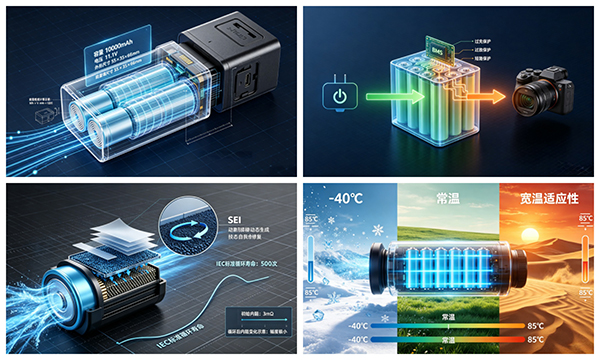
This trend has accelerated the upgrade of camera batteries from standard consumer-grade cells to high-energy-density power packs featuring long cycle life, wide temperature adaptability and intrinsic safety. For cameras that demand top-tier endurance, reliability and safety, four core attributes define market competitiveness: energy density dictates how much power fits within limited camera body space; cycle life determines long-term service lifespan; wide temperature tolerance enables stable operation in harsh outdoor environments; and intrinsic safety guarantees peace of mind during constant handheld use. These four pillars are essential for meeting professional users’ demands and achieving high-end product positioning.
Camera models vary in size, yet their working logic and application scenarios impose far more rigorous design standards on batteries than ordinary portable electronics:
Continuous long-duration power supply: Cameras must power multiple modules simultaneously during shooting, including image sensors, image processors, autofocus motors, image stabilization systems and high-brightness displays. Batteries require large capacity and a stable discharge platform to support hours of non-stop recording without power loss.
Optimal space compatibility & weight balance: Cameras are operated by hand or shoulder mounts. To reduce user fatigue and optimize overall center of gravity, batteries must be compact and lightweight while precisely matching the battery compartment dimensions of different camera models.
Reliable operation across wide temperature ranges: Cameras frequently operate in harsh outdoor settings, from frigid alpine ski resorts to blistering desert shooting locations. Batteries must deliver consistent discharge performance and reliable safety under extreme temperatures.
Long single-charge runtime & fast charging support: Whether for all-day outdoor film crews or daily amateur recording, camera batteries need enough capacity for hours of shooting per full charge and fast-charging capability to minimize downtime between shoots.
Outdoor action follow-up shooting: Cinematographers follow skiers speeding down mountain slopes at temperatures as low as -20°C. Batteries must endure frigid conditions and consistent vibration while maintaining uninterrupted power to avoid sudden shutdowns.
Long-duration studio live broadcasts: Live streams run 4–6 hours with cameras powered on continuously. Batteries must maintain steady output without overheating; mid-stream battery replacement directly causes broadcast failures.
Summer outdoor documentary shooting: Surface temperatures exceed 50°C in deserts or coastal beaches. Robust safety protection mechanisms are the top priority for batteries operating at high temperatures for extended periods.
Among all battery technologies, high-performance lithium-ion battery pack manufacturers dominate the camera market thanks to their well-rounded performance advantages.
| Core Requirement | Battery Pack Solution |
| Long-lasting Endurance | High-energy-density material systems deliver ample power within limited camera body space to support hours of continuous shooting. |
| Safe & Stable Operation | Built-in intelligent BMS (Battery Management System) monitors voltage, current and temperature in real time, delivering multi-layer hardware safeguards against overcharging, overdischarging, short circuits and overheating to eliminate safety risks at the source. |
| Extended Cycle Lifespan | Premium cells retain over 80% of original capacity after 500 deep charge-discharge cycles, drastically extending equipment service life and lowering replacement costs. |
| Wide Temperature Adaptability | Optimized low-temperature and heat-resistant material formulas maintain stable discharge performance from -40°C to 85°C, easily adapting to complex outdoor environments. |

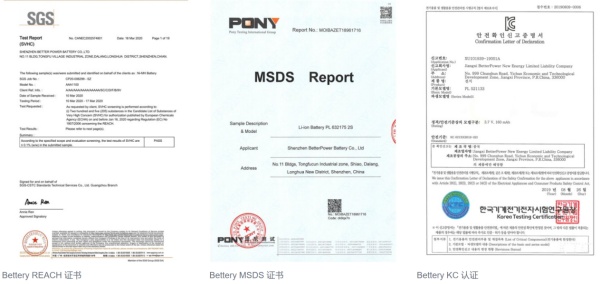
Intrinsic safety for handheld use is another critical advantage. Premium lithium camera batteries hold globally recognized safety certifications including UN38.3, UL, CE, RoHS, PSE and KC. Integrated protection circuits and hardware protection boards cut off power within milliseconds during abnormal overheating, external short circuits, overcharging or overdischarging, protecting both users and camera equipment.
With years of specialized battery manufacturing experience, BPI (Better Power Industry) is a National Specialized, Refined, Distinctive & Innovative "Little Giant" Enterprise with extensive expertise in high-reliability fields including digital devices, smart equipment and medical instruments.
Core Specifications of BPI Dedicated Camera Battery
| Item | Parameter |
| Nominal Capacity | 10,000mAh |
| Overall Dimension | 55×35×66mm |
| Cycle Life | 500 cycles per IEC standards |
| Operating Temperature | -40°C ~ 85°C |
BPI’s lithium battery lineup covers high-energy-density and high-rate power systems, fully customizable for diverse camera use cases: lightweight designs for portable handheld cameras, and large-capacity long-endurance solutions for professional broadcast cameras. Our high-energy-density series paired with intelligent BMS are widely adopted in visual equipment requiring superior stability, runtime and safety.
All product designs are fully scenario-driven. To address cameras’ dual core demands of long continuous power supply and harsh environment adaptability, BPI strictly selects cells formulated with temperature-resistant materials and implements rigorous cell consistency control, ensuring stable battery performance through thousands of charge-discharge cycles and exposure to extreme outdoor conditions.
For safety, BPI camera batteries integrate four layers of protection against overcharging, overdischarging, short circuits and overheating. Protection circuits monitor voltage and current of every single cell in real time, cutting off the circuit instantly upon abnormalities to eliminate hazards. All products pass global mainstream safety certifications including UN38.3, UL, CE, RoHS, REACH, PSE and KC for guaranteed quality.
Cameras from different brands and models feature unique requirements for battery voltage platforms, communication protocols and physical dimensions. Improperly matched batteries may trigger abnormal power level display, device recognition failures or complete operational breakdowns.
Outdoor camera shooting exposes batteries to constant vibration, drops and temperature fluctuations. Battery packs lacking rigorous reliability testing tend to suffer internal solder joint detachment and broken protection wires after prolonged use, leading to equipment failure or even potential safety hazards.
Standard digital cells are designed for intermittent-use devices such as smartphones and power banks. When deployed in professional cameras for long-duration high-load shooting or extreme temperature environments, they suffer unstable voltage output, system malfunctions and drastically shortened runtime.
The most vital components of professional filming gear are often unassuming — this applies equally to cameras and their internal power batteries.
BPI camera batteries deliver consistent value through three core strengths: long runtime, extended service life and top-tier safety. The 10,000mAh large capacity ensures uninterrupted shooting for hours; 500-cycle lifespan cuts long-term operational costs; intelligent BMS protection and wide-temperature compatibility enable fully secure handheld operation. Supported by strict quality control systems, BPI batteries maintain stable performance year after year, allowing visual creators to focus entirely on capturing every remarkable moment.
For filming equipment, batteries are far more than simple energy storage units — they form the foundation of the device’s full endurance, reliability and safety architecture. BPI adheres to stringent standards throughout product development and manufacturing, with fully traceable and controllable production workflows. Battery performance changes are predictable, risks are manageable, and consistent quality is guaranteed over the full service life.
For cinematographers, choosing BPI means no constant power checks, no unexpected shutdowns in cold weather, and zero safety concerns during critical shoots — letting creators focus solely on framing the perfect shot.
We provide more than batteries; we deliver the most dependable power backup for every shooting session. With long runtime, long lifespan and industry-leading safety, BPI safeguards every creative project!
A: Yes. We develop custom multi-cell packs with different voltage platforms (7.2V/7.4V/11.1V/14.4V, etc.) and irregular form factors tailored to the dimensional and interface requirements of camera battery compartments. Our product range includes brand-specific and professional bayonet-style mounting options.
A: Our intelligent BMS features high-precision voltage and current sampling with real-time monitoring, perfectly coordinating with the camera’s main control power management algorithm to deliver smooth current output amid dynamic load shifts such as power-on startup, zooming and image stabilization. Integrated multi-layer safeguards against overcharging, overdischarging, short circuits and overheating guarantee intrinsic safety under all operating conditions.
A: Absolutely. BPI batteries pass mainstream global safety certifications including UN38.3, UL, CE, RoHS, PSE and KC. Manufacturing complies with advanced quality management systems to help clients sell their camera products worldwide.