Medical rehabilitation devices are critical carriers for safeguarding patients’ health and quality of life, and a stable and reliable power supply is the core support for their efficient operation. With advantages including high energy density, slimness, flexibility, safety and environmental friendliness, pouch lithium batteries have become the ideal power choice for medical rehabilitation equipment such as blood pressure monitors, blood glucose meters and rehabilitation physiotherapy instruments.
Medical rehabilitation devices fall into three categories: vital sign monitoring, rehabilitation physiotherapy, and portable assistance. Different scenarios impose differentiated requirements on battery voltage, capacity and stability.
Vital sign monitoring devicesRepresented by blood pressure monitors, blood glucose meters and oximeters, these devices require frequent start-stop and long-term standby, demanding batteries with low self-discharge, small size and stable output.For example, household electronic blood pressure monitors usually operate once or twice daily with low working current, requiring batteries to support several months or even one year of standby. Blood glucose meters must maintain accurate measurement at low temperatures, imposing high requirements on battery wide-temperature performance.
Rehabilitation physiotherapy devicesIncluding intermediate-frequency physiotherapy instruments, low-frequency pulse therapeutic devices and portable rehabilitation trainers, these devices feature relatively high working current and require continuous power supply to complete physiotherapy cycles, demanding higher battery capacity and discharge rate.For example, portable intermediate-frequency physiotherapy instruments can run up to 30 minutes per session, requiring batteries to deliver stable high-current output while keeping the device lightweight and portable.
Portable assistance devicesSuch as portable nebulizers, power supply modules for walkers and smart rehabilitation braces, these devices emphasize portability and battery life, requiring batteries to provide sufficient energy within limited volume, along with excellent impact resistance and safety.
Power requirements of medical rehabilitation devices define the typical voltage and capacity configurations of pouch lithium batteries:
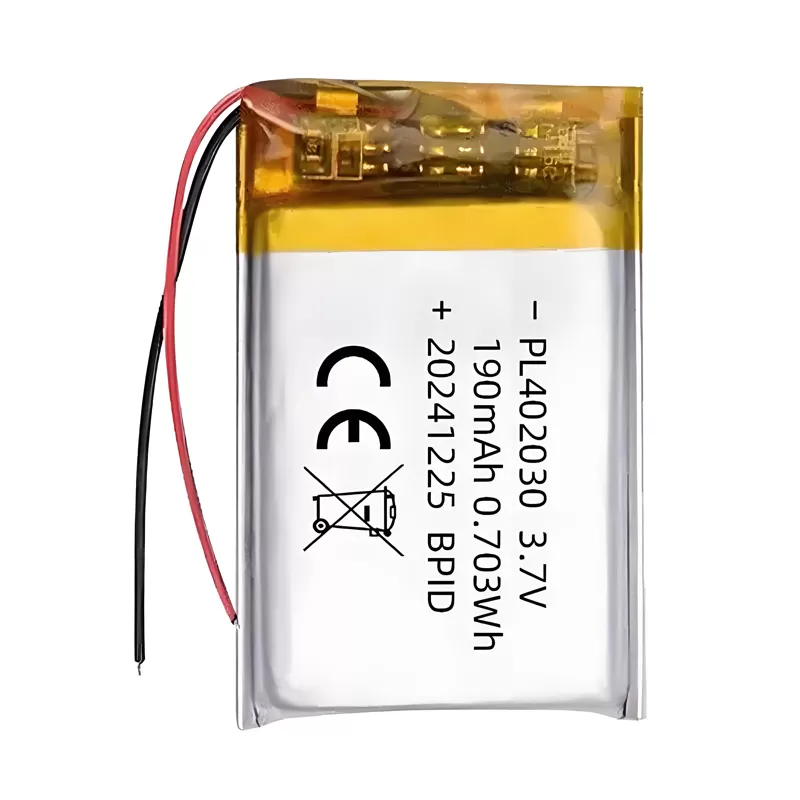
Voltage systemThe mainstream solution is a single-cell 3.7V (4.2V full charge) pouch battery. Some high-power devices adopt a 2-series combination (7.4V) to meet voltage demands for motor driving or high-frequency circuits.The 3.7V single-cell scheme is the first choice for small devices such as blood pressure monitors and blood glucose meters due to its simple structure and compact size. The 7.4V scheme is mostly used for rehabilitation physiotherapy instruments requiring higher driving power.
Capacity rangeCapacity covers 70mAh to 10000mAh according to device power consumption.Small monitoring devices (blood glucose meters, micro oximeters) usually use 70mAh–450mAh small-capacity batteries for ultra-slim design.Medium physiotherapy devices (intermediate-frequency instruments) mostly adopt 2000mAh–5000mAh to balance battery life and portability.Large portable assistance devices (portable nebulizers) can select 8000mAh–10000mAh high-capacity batteries to support long-hour operation.
As a professional lithium battery manufacturer, BPI pouch lithium batteries precisely meet the stringent requirements of medical rehabilitation devices in performance, specifications, certifications and other dimensions.
Complete specifications and strong customization capabilityBPI stably produces more than 1,000 pouch lithium battery models, covering the full capacity range from 70mAh micro batteries to 10000mAh single high-capacity cells. Voltage options include 3.7V, 3.8V, 3.85V and more, directly matching the voltage and capacity needs of blood pressure monitors (70mAh–280mAh), blood glucose meters (390mAh–450mAh), physiotherapy instruments (2000mAh–10000mAh) and other devices. Customization of size, shape and performance parameters is also supported.
Wide-temperature performanceBPI wide-temperature batteries operate stably from -30°C to 80°C. Ultra-low-temperature models maintain 90% discharge efficiency at -40°C under 0.2C, meeting the demands of medical devices in extreme environments such as low-temperature wards and field first aid.
Long cycle lifeLong-cycle models support more than 1,000 cycles, and some models reach 1,500 cycles via special material design — far exceeding industry standards — greatly reducing battery replacement frequency for medical devices.
High-rate and high-temperature adaptabilityHigh-rate batteries support 15C continuous discharge to meet instantaneous high-current demands of physiotherapy instruments. High-temperature batteries support 45°C high-temperature cycling, suitable for long-time continuous operation of medical devices.
Complete certifications and safety complianceBPI batteries have obtained authoritative domestic and international certifications including GB/T 36276, UL1973, IEC62619, UN38.3, complying with safety standards for medical electronic devices. They also hold environmental qualifications such as MSDS and RoHS, ensuring safe export and clinical use of medical products.
Mature material system and high reliabilityAdopting mature material systems including LCO, NCM and LFP, BPI batteries feature low internal resistance and low self-discharge rate, providing long-term stable power supply for medical devices and avoiding measurement errors or equipment failures caused by battery fluctuations.
Medical rehabilitation devices have extremely high requirements for power safety, stability and portability, making pouch lithium batteries the core power source in this field.With complete specifications, excellent environmental adaptability, reliable cycle life and a sound certification system, BPI precisely matches the battery needs of various medical rehabilitation devices including blood pressure monitors, blood glucose meters and rehabilitation physiotherapy instruments, providing solid power support for the intelligent and portable development of the medical rehabilitation industry.