A gaming mouse is a precision input device specifically designed for esports and high-performance gaming scenarios. It typically comprises an optical sensor, main control chip, microswitch, wireless communication module, and built-in power system. During use, the player slides the mouse across a mouse pad; the sensor captures displacement, the main control chip processes the data, and instructions are transmitted to the computer host via wireless technologies such as 2.4 GHz or Bluetooth. Meanwhile, the built-in polymer lithium battery continuously supplies stable power to the sensor, wireless module, RGB lighting effects, and other components. In this way, players can enjoy unrestrained wireless operation even during intense team fights, free from cable constraints. Modern gaming mice have evolved from early wired products into intelligent peripherals integrating high-performance sensors (26,000 DPI+), ultra-high polling rates (4,000 Hz / 8,000 Hz), ultra-lightweight design (< 60 g), programmable buttons, and RGB phantom lighting effects.
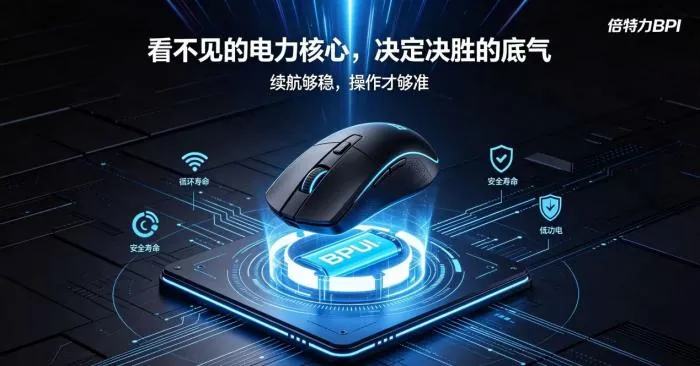
Whether a gaming mouse offers "enough battery life to last through an all-night ranked match," whether its "battery life collapses after six months of use," or whether it "suddenly powers off in high polling-rate mode" often depends on the critical polymer lithium battery hidden inside the chassis, charging and discharging day and night.
In recent years, with the rapid development of the esports industry, the maturation of professional tournament systems, and continuous breakthroughs in wireless communication technology and low-power sensor solutions, wireless gaming mice have transitioned from the "exclusive equipment" of a minority of professional players to essential tools on the desktops of everyday gamers. In MOBA team-fight scenarios, they help players break free from cable drag interference during extreme positioning maneuvers; in FPS shooting scenarios, they grant players greater freedom of control during flick shots and crosshair tracking; in extended training or live-streaming sessions, they serve as critical partners ensuring operational continuity and eliminating cable entanglement hassles. Wireless gaming mice are no longer merely peripherals transmitting click and movement commands—they are becoming key equipment connecting players to victory, determining the ceiling of operational performance and competitive experience.
Against this backdrop, the power system is not only a source of energy but also the core cornerstone of product performance and user experience. The industry's central concern is not how high the DPI is or how dazzling the lighting effects are, but whether the device remains stable and reliable at critical moments—when a player is in the decisive team fight of a ranked match, can the mouse sustain operation for the entire round without suddenly powering off during a skill combo? When professional players repeatedly perform high-intensity flick-shot operations during training matches, can signal transmission remain real-time and fluid without delay or stutter? When the device must withstand several hours of daily high-intensity use and frequent charge/discharge cycles, can the battery's cycle life withstand the test, and will its battery life be "cut in half" after six months of use? When the battery operates under prolonged high-load discharge conditions, is its internal structure safe and controllable, and will it overheat or swell?
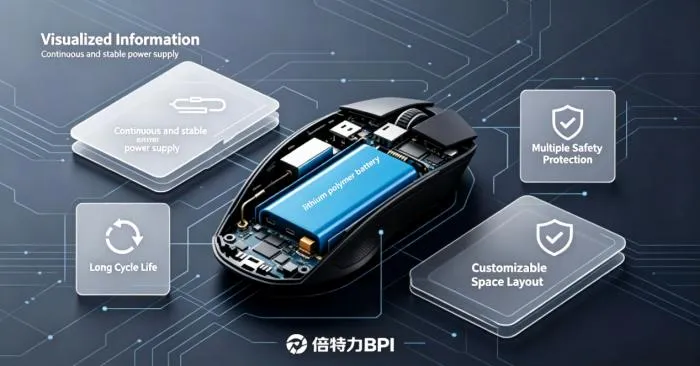
This has directly driven the evolution of gaming mouse batteries from "ordinary consumer-grade cells" toward "high energy density, high-rate discharge, long cycle life, multi-layer safety protection, and low self-discharge." Therefore, in gaming mice—a device closely tied to competitive performance and requiring prolonged high-load operation—the battery's endurance persistence, high-current output stability, and safety reliability have become the foundation determining whether a product can truly impress hardcore players and move toward premium positioning.
This imposes technical requirements on batteries far more stringent than ordinary consumer electronics, mainly manifested in the following four aspects:
Continuous Stable Power Supply: Gaming mice consume extremely high power during gaming scenarios—the sensor continuously samples at 1,000 Hz or even 8,000 Hz polling rates, the wireless module transmits at high frequency, and RGB lighting effects remain illuminated. Instantaneous power consumption can reach several times that of ordinary office mode. The battery must feature low internal resistance design to ensure stable voltage without sagging during high-current output, eliminating the embarrassment of "sudden power-off at the critical moment of a team fight."
Long Cycle Life: Esports players average 6–10 hours of daily use, charging whenever convenient and frequently plugging and unplugging. The battery remains in a deep charge/discharge state for extended periods. The battery must support ≥ 500 cycle life (80% capacity retention), ensuring no noticeable endurance degradation after six months to one year of use.
Multi-Layer Safety Protection: Under high-intensity gaming scenarios, sustained high-current battery discharge may generate overheating risks. The battery must feature a built-in intelligent protection board with hardware-level protection mechanisms including overcharge, over-discharge, overcurrent, short-circuit, and overheating protection, eliminating safety hazards from the source.
Customized Space Adaptation: Lightweight gaming mice offer extremely limited internal space, with some products weighing as little as 36–57 g total. The battery must utilize polymer pouch cells, supporting full customization of dimensions, capacity, voltage, protection board, and wire connectors to perfectly embed into compact chassis designs.
Among various battery technology routes, polymer batteries have become the mainstream power solution for gaming mice by virtue of their comprehensive performance advantages. The reason is that they perfectly align with the core requirements of gaming mice:
| Core Requirement | Polymer Lithium Battery Solution |
| Long-Lasting Endurance | Utilizes a high energy density lithium cobalt oxide system paired with a low-power-consumption main control solution. 300–800 mAh capacity can sustain 70–275 hours of continuous gaming; low internal resistance design ensures stable voltage without sagging in high polling-rate mode. |
| Slim and Lightweight Adaptation | Adopts pouch polymer cells with flexible customization of thickness, width, and length according to internal device space, perfectly embedding into the compact chassis of lightweight mice without adding weight burden. |
| Long Cycle Life | Quality polymer cells maintain over 80% capacity retention after more than 500 deep charge/discharge cycles, covering a complete 2–3 year usage cycle. |
| Intelligent BMS Management | Cooperates with a precision Battery Management System (BMS) to achieve real-time monitoring of voltage, current, and temperature, providing multi-layer hardware-level protection including overcharge, over-discharge, overcurrent, short-circuit, and overheating protection. |
Established in 2002, BPI operates a headquarters in Shenzhen and a 200-mu wholly-owned intelligent manufacturing base in Yichun, Jiangxi. It is a national high-tech enterprise integrating lithium battery, nickel-metal hydride battery, PACK, and energy storage product R&D, production, and sales, with annual revenue exceeding RMB 500 million. Daily production capacity reaches 800,000 units for nickel-metal hydride and lithium batteries, with products sold to over 80 countries worldwide. BPI has deeply cultivated international brand OEM/ODM supporting partnerships. The company holds more than 130 core battery patents, with multiple technologies including high-temperature explosion prevention, long-lasting low self-discharge, and nickel-zinc batteries leading the industry. It has established industry-university-research bases with Tsinghua University and Tianjin University, combining automated production lines, global distribution channels, independent innovation technology, and standardized enterprise management. BPI is a comprehensive battery solution provider with strength in production capacity, technology, and safety.
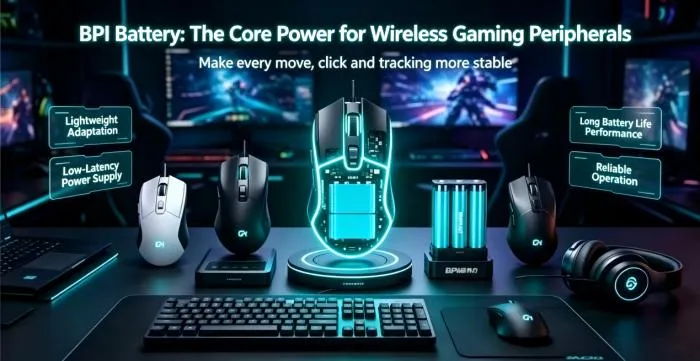
BPI lithium batteries cover both high energy density systems and high-rate discharge systems, enabling combined and customized development for different gaming mouse product forms. Among these, the high energy density series and intelligent protection board solutions have been widely applied in esports peripherals with extremely high requirements for endurance, high-current output, and reliability. During the product design phase, BPI orients development toward application scenarios—addressing the two core demands of gaming scenarios: "high-intensity continuous gaming" and "frequent deep charge/discharge." It implements dedicated optimization in cell materials and formulations. Utilizing a high energy density lithium cobalt oxide system, it delivers larger capacity in the same volume, with 300 mAh sustaining 70–275 hours of continuous gaming. By optimizing electrode structure and electrolyte formulation, cycle stability is substantially improved, maintaining over 80% capacity retention after more than 500 deep charge/discharge cycles, ensuring that the device's long-term use endurance does not collapse and performance does not degrade.
Ordinary digital cells are primarily designed for low-power, short-duration devices such as mobile phones and Bluetooth earphones, with narrow charge/discharge windows and relatively low cycle life standards. When applied to gaming mice—devices requiring prolonged high-load operation and frequent deep charge/discharge—power consumption instantly climbs to several times normal levels when users simultaneously activate high polling-rate mode, wireless transmission, and RGB lighting effects. Battery voltage drops sharply, causing frequent mouse stuttering or even unexpected shutdown. Cells operating under prolonged high-depth charge/discharge conditions suffer rapid cycle life degradation: battery life is acceptable at product launch, but after 3–6 months, player negative reviews concentrate and explode: "After less than six months, battery life is only half."
Many brands' battery testing is limited to "how long the fully charged new device can last," conducted in ideal laboratory conditions. However, real-world player scenarios are far more complex: power consumption increases during wireless signal interference, high polling-rate mode combined with constant RGB illumination dramatically increases power consumption, and frequent transitions between gaming and standby wake-up states. More critically, these issues tend to concentrate and become exposed only after battery cycle aging: "Initial endurance 200 hours, 120 hours after three months, and after six months it can't even last through an all-night ranked match." Brands lack hard requirements for cycle life (≥ 80% capacity retention after 500 cycles) and fail to verify user experience details such as low-battery warning accuracy and fast-charge compatibility.
In advanced esports peripherals, the truly critical components are often not the most dazzling. This holds true for gaming mice, and equally so for the power batteries inside them.
It is through stable, reliable, predictable, and intrinsically safe performance that BPI polymer lithium batteries continuously deliver value in these "invisible yet experience- and victory-critical" core positions. They not only provide persistent, uninterrupted power support for the device—fully charged, sustaining 70–275 hours of continuous gaming—but also, through stringent quality control, ensure that capacity retention remains above 80% after more than 500 deep charge/discharge cycles, keeping the device rock-solid after years of high-intensity use with undiminished combat power. The built-in intelligent protection board works in coordination with NTC thermistors to cut off abnormal risks including overcharge, over-discharge, short-circuit, and overheating at the millisecond level, making every player operation more precise and every match more reassuring.
In esports peripheral applications, the battery is never a simple energy storage component but a core element of the entire device's performance and reliability system. BPI consistently adheres to strict standards as the fundamental criterion for product development and manufacturing, with full-process traceability and control. Over the product's 2–3 year usage cycle, performance changes are predictable, risks are controllable, and quality is assured.
For gaming mouse batteries, choose endurance, choose stability, choose BPI!
Q: Is the battery safe? Will it overheat or swell during prolonged high-load gaming?
A: Safe and reliable. BPI batteries have passed globally mainstream safety certifications including UL, CE, RoHS, UN38.3, and KC. The built-in hardware protection board and NTC thermistor can cut off the circuit at the millisecond level when abnormalities such as overcharge, over-discharge, short-circuit, or overheating occur. The pouch aluminum-laminate film packaging only swells to relieve pressure without rigid explosion, providing dual-layer protection—ensuring complete peace of mind for devices in high-intensity competitive scenarios.
Q: Does the battery have a "memory effect"? Must it be fully discharged before recharging?
A: No memory effect. BPI polymer lithium batteries differ from older nickel-metal hydride / nickel-cadmium batteries and do not require "full discharge before recharge." Charge as you use and use as you charge; frequent "deep discharge" actually accelerates electrode material fatigue. Users can follow normal usage habits for charging—topping up intermittently during the day and gaming at full charge in the evening—with no impact on battery life.