A wireless security camera (wireless surveillance camera) is an intelligent monitoring device powered by a built-in battery and transmitting video signals via Wi-Fi or 4G/5G networks. In simple terms, it can be regarded as an "electronic sentry that requires no plugging in and stands ready at all times." In scenarios such as home care, shop security, outdoor farms, and temporary construction sites, wireless cameras enable users to "break free from cable constraints and achieve remote viewing anytime, anywhere." Through high-sensitivity image sensors, intelligent PIR human-body detection algorithms, and low-power wireless communication modules, it detects abnormal movements in real time and pushes alerts, allowing homeowners thousands of miles away to have complete situational awareness of the site.
How long a wireless security camera can "remain on standby," whether its "night vision is clear," and whether it "loses power in winter" often depends on the key power battery hidden within its compact body.
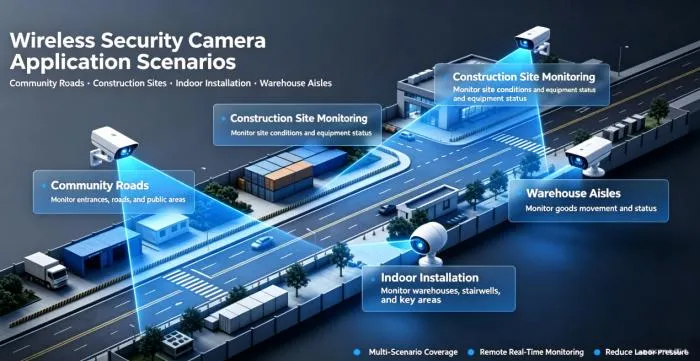
In recent years, with the proliferation of IoT technology, the maturation of smart home ecosystems, and rising public anxiety about home security, wireless security cameras have transitioned from the engineering lists of professional security companies to the doorways and courtyards of millions of households. In home scenarios, it serves as a considerate guardian for caring for the elderly and children and preventing burglaries; in commercial scenarios, it acts as a capable assistant for shop owners conducting remote patrols and deterring criminals; in outdoor and engineering scenarios, it functions as a safety recorder for temporary job sites. Wireless cameras are no longer merely conceptual tech products—they are becoming critical infrastructure for protecting personal and property safety and enhancing quality of life.
Against this backdrop, the power supply system is not only a source of energy but also the core of product reliability and user experience. The industry's central concern is not how many megapixels the camera has, but whether it can function properly at critical moments—when a burglar breaks in late at night, can the battery sustain the camera to complete high-definition recording and push an alert? When the camera is installed outdoors and exposed to extreme heat and cold, can the battery maintain stable output? When the device undergoes repeated charge/discharge cycles during long-term unattended operation, can the battery's lifespan withstand the test?
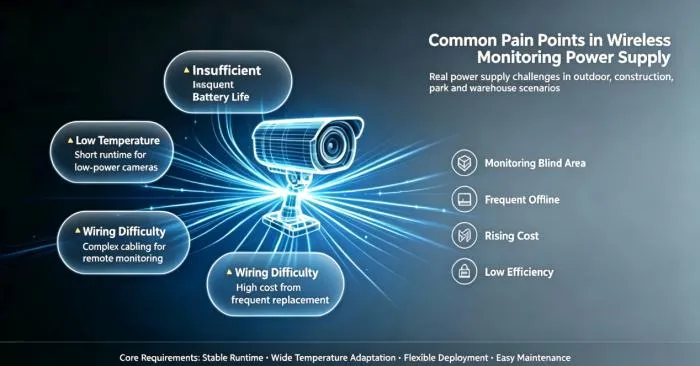
This has directly driven the evolution of wireless security camera batteries from "ordinary digital battery cells" toward "high energy density, long cycle life, wide temperature tolerance, and intrinsic safety." Therefore, in wireless camera systems requiring long-term outdoor unattended operation, the battery's safety, stability, and cycle life have become the foundation determining whether a product can truly impress consumers and move toward premium positioning.
Although the overall power consumption of wireless cameras is far lower than that of power tools, their working principles and usage logic impose quite stringent design requirements on batteries—far more complex than ordinary portable electronic products:
Frequent PIR Wake-ups and Pulse Discharge: Wireless cameras typically remain in sleep mode to extend standby time, but when the PIR sensor detects human movement, the system must wake up instantly. The system needs to immediately initiate Wi-Fi connection, image capture, and even video recording. This process requires the battery to possess excellent instantaneous high-current output capability to support rapid system startup and data upload.
Wide-Temperature Outdoor Operating Environment: Cameras are often installed outdoors. Internal temperatures can become very high under summer sun exposure, while severe winter cold increases internal resistance, causes capacity degradation, and may even prevent discharge; high temperatures accelerate cell aging. The battery must maintain stable charge/discharge performance across a broad temperature range.
Ultra-Long Cycle Life and Low Self-Discharge: Wireless cameras are often installed in hard-to-reach high places or outdoor corners, and users do not wish to disassemble and recharge them frequently. This requires the battery to not only have sufficient capacity but also feature long cycle life and extremely low self-discharge rates to support long-term stable operation of the entire device.
Stringent IP Protection and Structural Strength: Outdoor cameras must possess good water and dust resistance ratings. As a core component, the battery pack's casing structure and sealing design must completely prevent rainwater infiltration while also withstanding sand, sun exposure, and certain physical impacts.
Among various battery technology routes, high-performance lithium-ion batteries have become the mainstream power solution for wireless security cameras by virtue of their comprehensive performance advantages. The reason is that they perfectly align with the core requirements of wireless surveillance:
| Item | Standard Model | Heated Model |
| Battery Type | Pack | Pack |
| Dimensions | 66 × 77 × 19 mm | 66 × 77 × 19 mm |
| Voltage | 3.7 V | 3.7 V |
| Capacity | 10,000 mAh | 10,000 mAh |
| Specific Model | 18650 × 4P-10,000 mAh | 18650 × 4P-10,000 mAh with heating film |
| IEC Cycle Life | 300 cycles | 500 cycles |
| Initial Internal Resistance | ≤ 85 mΩ | ≤ 100 mΩ |
| Core Features | Lower internal resistance; cost-effective choice for conventional indoor and outdoor monitoring scenarios | Built-in heating function effectively addresses low-temperature environments; longer cycle life |
Addressing the characteristics of wireless cameras—dispersed deployment, complex outdoor environments, and high operation and maintenance costs—BPI Lithium Battery has launched a security surveillance-dedicated 10,000 mAh large-capacity PACK solution.
BPI security surveillance batteries cover both standard energy-type and heating-function systems, enabling combined and customized development for different wireless camera application scenarios (such as indoor low-power always-on types and outdoor cold-region types). Among these, the heating-function series and intelligent BMS solutions have been widely applied in security surveillance systems with extremely high requirements for low-temperature adaptability, cycle life, and safety performance.
During the product design phase, BPI orients its development toward application scenarios. Addressing the two major pain points of wireless cameras—"outdoor wide-temperature operation" and "long-term cyclic use"—BPI has implemented reinforced designs in cell formulation and PACK structure. It adopts customized battery formulations to ensure perfect matching between battery performance and device operating conditions; simultaneously, through strict cell consistency control and full-process quality inspection, it ensures stable and reliable battery pack performance during long-term use.
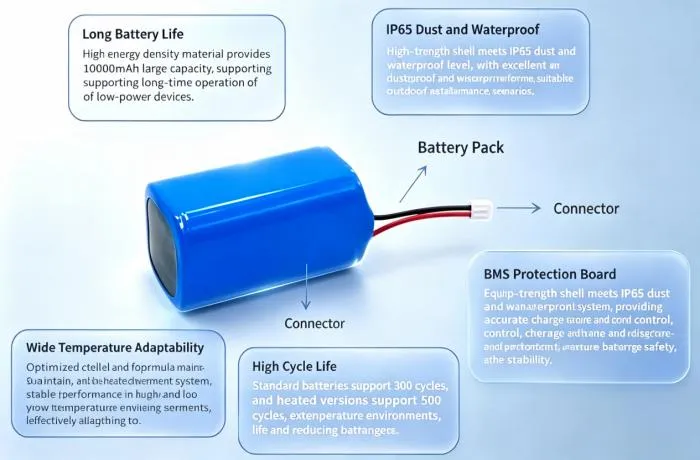
Key parameter comparisons of the two core models are as follows:
| Item | Standard Model | Heated Model |
| Battery Type | Pack | Pack |
| Dimensions | 66 × 77 × 19 mm | 66 × 77 × 19 mm |
| Voltage | 3.7 V | 3.7 V |
| Capacity | 10,000 mAh | 10,000 mAh |
| Specific Model | 18650 × 4P-10,000 mAh | 18650 × 4P-10,000 mAh with heating film |
| IEC Cycle Life | 300 cycles | 500 cycles |
| Initial Internal Resistance | ≤ 85 mΩ | ≤ 100 mΩ |
| Core Features | Lower internal resistance; cost-effective choice for conventional indoor and outdoor monitoring scenarios | Built-in heating function effectively addresses low-temperature environments; longer cycle life |
1. Misconception One: Pursuing Capacity Alone While Neglecting Low-Temperature Performance. Many manufacturers focus only on "how large the capacity is" during selection, without considering whether the battery can operate normally under low-temperature winter conditions. Ordinary batteries experience increased internal resistance and sharply reduced discharge capability at low temperatures, potentially causing the device to shut down directly and rendering surveillance useless. BPI's heated model effectively reduces the risk of low-temperature "shutdown" through its built-in heating function.
2. Misconception Two: Applying Ordinary Consumer-Grade Digital Battery Cells. Digital battery cells are primarily designed for indoor constant-temperature environments such as mobile phones and power banks, with limited cycle life. When used in outdoor wireless cameras, frequent charge/discharge cycles and ambient temperature variations accelerate aging. BPI's heated model achieves a cycle life of 500 cycles, better aligning with the long-cycle usage requirements of security equipment.
3. Misconception Three: Insufficient Structural Protection, Neglecting Long-Term Outdoor Aging. Battery packs without IP protection design, when used outdoors over extended periods, are highly susceptible to short-circuit failure after rainwater or moisture intrusion, and may even trigger safety hazards. BPI products adopt an IP65-rated water and dust resistant casing design, providing reliable protection for outdoor installation.
In advanced intelligent security equipment, the truly critical components are often not the most dazzling. This holds true for wireless cameras, and equally so for the power batteries inside them.
It is through stable, reliable, predictable, and intrinsically safe performance that BPI lithium batteries continuously deliver value in these "invisible yet experience- and safety-critical" core positions. They not only provide persistent, stable power output for cameras but also, through stringent quality control and differentiated product design (such as the heated model with 500-cycle lifespan), ensure that devices remain rock-solid after years of outdoor operation, keeping people safe from security risks and allowing them to enjoy the peace of mind brought by technology.
In wireless security device applications, the battery is never a simple energy storage component but a core element of the entire device's reliability system. BPI consistently adheres to strict standards as the fundamental criterion for product development and manufacturing, with full-process traceability and control. Over the product's multi-year service life, performance changes are predictable, risks are controllable, and quality is assured.
For wireless security surveillance batteries, choose safety, choose reliability, choose BPI!
Q: Does BPI's wireless camera battery solution support structural customization?
A: Yes. We can provide battery pack customization for different voltage platforms, dimensional specifications, and irregular structures based on the space constraints of the device's internal cavity, while also supporting plug types, wire routing methods, and other adaptations as required.
Q: Regarding the pain points mentioned above, how does BPI specifically address them?
A: To address the issue of inability to operate normally at low temperatures, we have launched the heated model, featuring a built-in intelligent temperature-controlled heating module that actively warms the cells in low-temperature environments before supplying power externally, ensuring stable camera operation. To address short cycle life, the heated model has been increased to 500 cycles (standard model: 300 cycles), reducing replacement frequency. To address outdoor waterproofing, the entire series adopts an IP65-rated water and dust resistant casing, ensuring long-term reliable outdoor operation.
Q: Do the products comply with certification requirements for entering global markets?
A: Yes. BPI products have passed globally mainstream safety certifications including UN38.3, UL, CE, RoHS, REACH, and KC, and are strictly produced in accordance with advanced quality management system standards, helping client products sell successfully at home and abroad.