The educational tablet is a smart device designed for early childhood education, classroom learning for primary and secondary school students, and paperless teaching in schools. It features a high-definition touchscreen, stylus, high-resolution camera, and an AI-powered learning system, primarily used for online courses, e-textbook reading, exercise completion, personalized tutoring, online exams, and post-class video explanations. Powered by built-in lithium batteries, the device supports continuous operation of its CPU, display, and camera under heavy loads. Due to prolonged use throughout the day—whether at home, in classrooms, or during outdoor educational activities—the device requires exceptional battery endurance, excellent temperature resistance (both low and high temperatures), and high safety standards for long-term usage.
Home use scenarios: Early childhood education, online classes for students at home, evening practice and review sessions.
Campus Environment: Unified teaching terminals for classes, multimedia classrooms, and learning tablets used for campus inspections.
Outbound scenarios: educational trips, offline training sessions, mobile learning activities
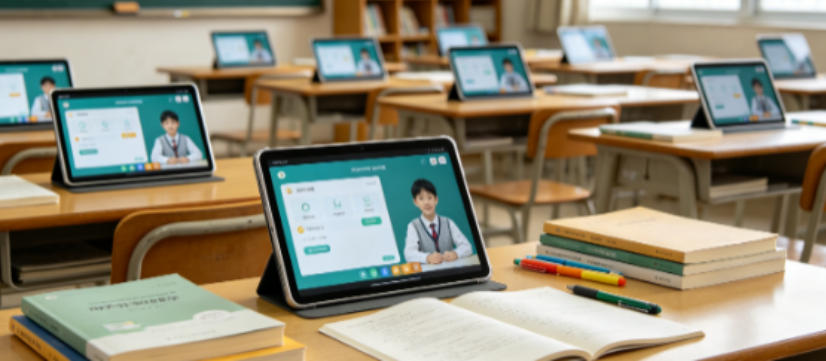
Standard digital batteries paired with educational tablets are prone to various malfunctions during prolonged use, directly compromising user experience and the brand's after-sales reputation.
1. Rapid battery life degradation: Standard cells only withstand 300–500 charge cycles, with range halving after just one year of use; frequent battery replacements by users place significant pressure on manufacturers' after-sales services.
2. Performance issues under heavy load (including lag and battery drain): prolonged online course playback or running multiple apps simultaneously can cause high internal resistance, voltage spikes, flickering screens, touch sensitivity issues, or sudden device shutdowns.
3. Poor adaptability to temperature variations: In winter, the device exhibits immediate black screen and significant power consumption drop when powered on in low-temperature classrooms; during prolonged online classes in summer, the battery continuously generates heat, leading to bulging and electrolyte leakage.
4. Poor body compatibility: The battery cells are thick and inflexible, occupying valuable internal space in the device, resulting in a bulky overall design that cannot accommodate irregular-shaped bodies.
5. Significant safety hazards exist: substandard battery cells lack adequate protection, posing risks of short circuits and thermal runaway due to prolonged heating, and pose high risks when used by minors.
6. Long custom development cycle: Standard battery cells have fixed dimensions that cannot accommodate the irregular internal cavities of new tablet models, extending the product development timeline.
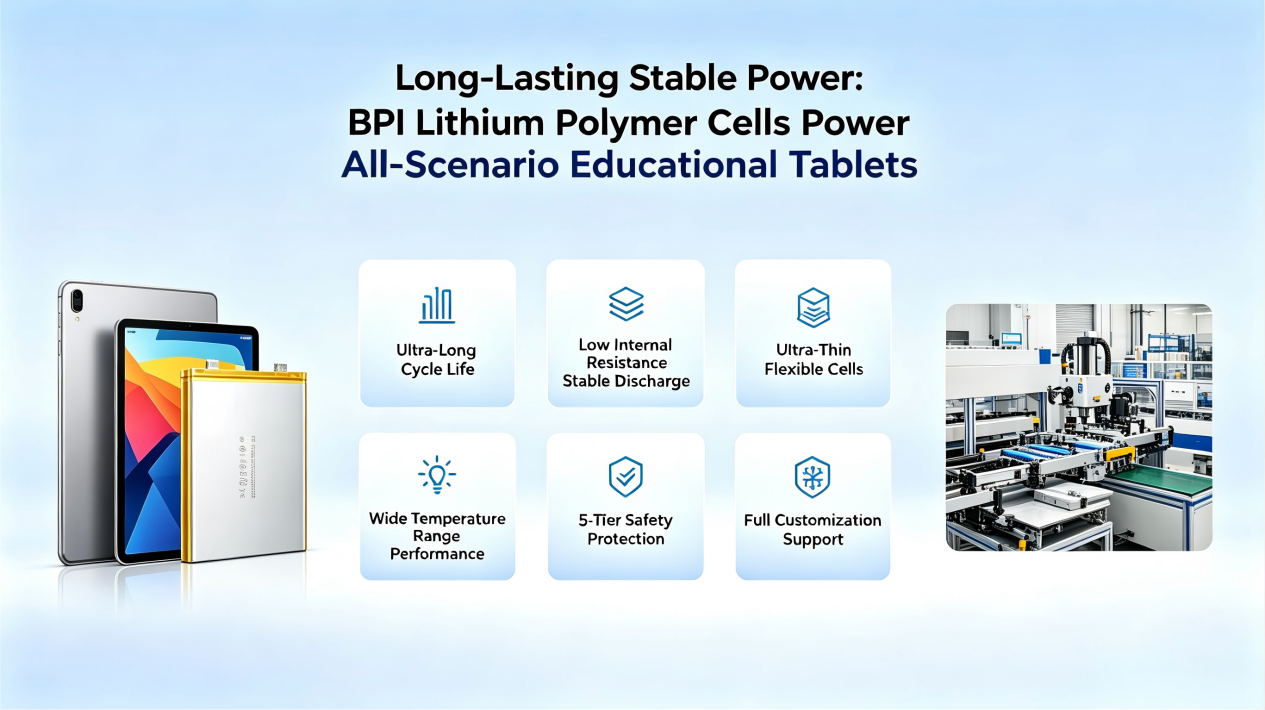
To address these industry challenges, lithium polymer cells designed for educational tablets must meet stringent performance requirements to fundamentally resolve operational issues.
1. Long cycle life: meets IEC standard cycles of ≥800 cycles, with slow capacity degradation during charging and discharging, reducing replacement frequency;
2. Stable discharge with low internal resistance: Featuring a low-resistance design that ensures minimal voltage drop under high-load conditions, delivering consistent output without lag or power loss.
3. Ultra-thin flexible packaging design: The battery cell is lightweight and highly adaptable, fitting seamlessly into various compact or irregularly shaped internal cavities.
4. Stable performance across wide temperature ranges: ensures stable discharge under both high and low temperatures, prevents battery degradation at low temperatures, generates minimal heat at high temperatures, and effectively suppresses bulging.
5. Five-layer security protection system: Integrated with an intelligent BMS, providing real-time protection against overcharging, overdischarge, excessive current, short circuits, and overheating.
6. High customization compatibility: Size, capacity, output configuration, and protection board can be customized to meet the needs of different device models.
Shenzhen BPI has dedicated 24 years to research and development lithium polymer manufacturers, specializing in comprehensive power battery solutions for consumer electronics, smart education devices, and portable equipment. The company possesses full industrial chain capabilities encompassing cell R&D, PACK assembly, and BMS development.
1. Production capacity: Equipped with proprietary standardized manufacturing facilities and multiple fully automated cell coating, winding, and packaging lines, capable of producing millions of cells daily to support long-term, stable large-scale supply for brands.
2. Quality Control System: Utilizes automotive-grade IATF 16949 quality management standards, encompassing comprehensive processes for cell sorting, high/low-temperature aging testing, and impact/compression safety evaluation.
3. Authoritative Certification: All products comply with global safety certifications including UN38.3, CE, UL, RoHS, PSE, and KC, ensuring both domestic and international market compliance for equipment sales.
4. Technical Patents: Holds multiple independently developed patents, including a wide-temperature cell formulation, a low internal resistance tab structure, and intelligent BMS protection technology.
5. Service Capacity: Our professional R&D engineers provide one-on-one consultation to swiftly develop customized solutions for individual cells and battery packs, significantly shortening customers' new product development cycles.
product model | outline dimension (mm) | nominal capacity | nominal voltage | IEC cycle life | Compatible Devices |
337093-2800mAh | 3.3×70×93 | 2800mAh | 3.7V | 800 times | 8-inch lightweight early education tablet and entry-level student learning device |
339898-4000mAh | 3.3×98×98 | 4000mAh | 3.7V | 800 times | 10-inch flagship tablet with large display, designed as a batch teaching terminal for educational institutions |
In addition to two standard spot battery cells, it supports comprehensive personalized development across all dimensions:
A: Yes. The standard model can have its length, width, and thickness adjusted, as well as its capacity modified; for flat batteries with specialized internal cavity structures, custom-made cells can be produced through new molding processes.
A: Supports customized dedicated battery management systems that perfectly integrate with the device's main control chip, remains compatible with existing fast-charging solutions, provides accurate battery level display, and ensures balanced charging without damaging cells.
A: The battery cell features a temperature-optimized formulation that ensures stable low-temperature discharge performance, with no voltage fluctuations or unexpected shutdowns in sub-zero environments, making it ideal for winter use in unheated classrooms and outdoor educational settings.
A: The battery cell features a low internal resistance design, resulting in reduced heat generation during high-load operation, complemented by intelligent overtemperature protection. It has undergone continuous high-temperature aging tests at the factory and can effectively prevent bulging and electrolyte leakage when used properly and in compliance with specifications.
A: All battery cells come with complete certification packages including UN38.3, CE, UL, RoHS, PSE, and KC, enabling direct sales to global markets such as Europe, the United States, and Southeast Asia without additional testing requirements.
The competition in the educational tablet market is intensifying, with battery life, stability, safety, and durability becoming key criteria for both consumers and school procurement decisions. As the core power source of the device, the battery directly determines a product's market competitiveness. Leveraging 24 years of lithium battery manufacturing experience, fully automated production lines, and a comprehensive safety certification system, BPI has developed two standardized soft-pack cells specifically designed for educational tablets, while also offering end-to-end customized lithium battery solutions that address industry challenges such as poor battery life, frequent performance fluctuations, inadequate temperature tolerance, and significant safety risks. Whether for early education tablets, home learning devices, or large-scale classroom teaching terminals, BPI provides reliable, stable, and safe power support, establishing itself as a trusted lithium battery partner for educational equipment brands.