With the widespread adoption of smart homes, window-cleaning robots have become essential equipment for cleaning in high-rise residential and commercial buildings. They completely eliminate the risk of falls associated with manual cleaning of exterior windows in high-rise structures by delegating high-risk cleaning tasks to automated devices, thereby achieving truly unmanned window cleaning in tall buildings.
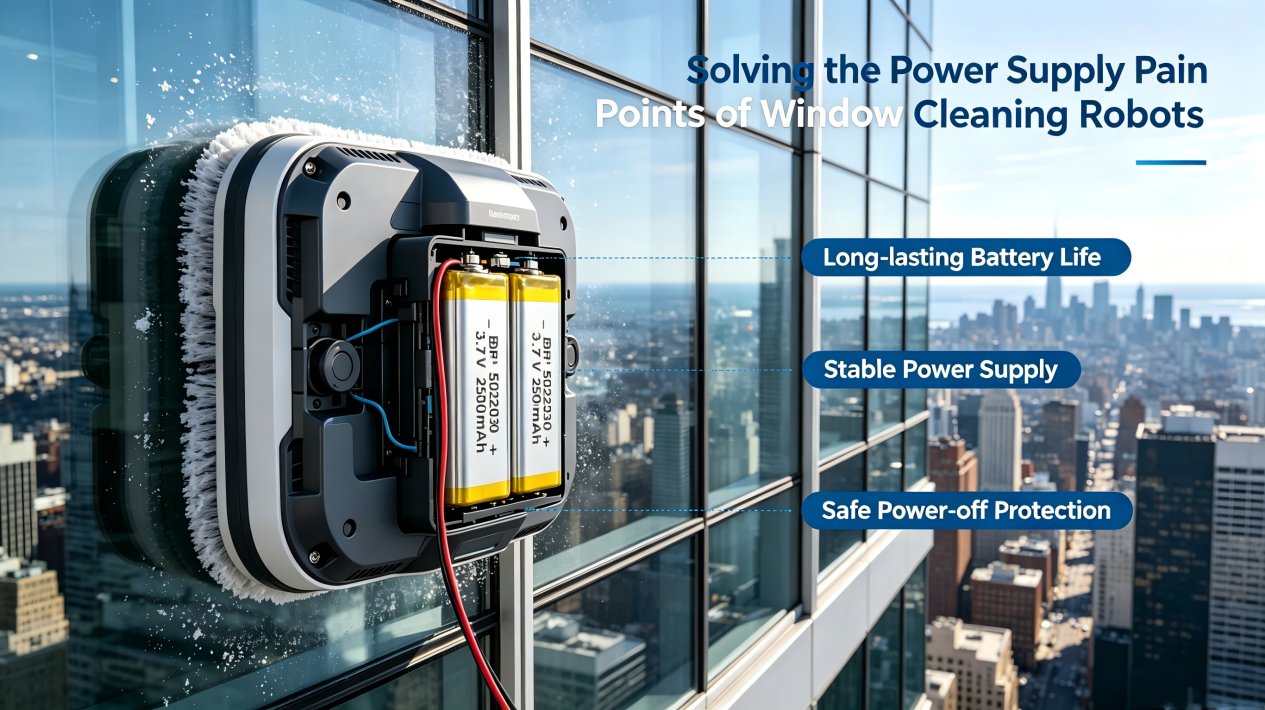
Window-cleaning robots are securely attached to glass surfaces via negative pressure suction, autonomously planning their movement paths and performing the entire cleaning process—including wiping, wiping with a glass cleaner, and removing contaminants—without requiring personnel to operate outside the window, thereby fundamentally preventing accidents associated with high-altitude work. In residential applications, these robots can easily be deployed for floor-to-ceiling windows in high-rise buildings, glass doors in sunrooms or bathrooms, and sliding balcony doors, addressing challenges related to difficulty or reluctance in cleaning exterior windows. For commercial settings, they are ideal for cleaning office building glass facades, hotel floor-to-ceiling windows, and public areas within property complexes, significantly reducing labor costs while enhancing safety and efficiency. Many property management companies adopt human-robot collaboration systems, achieving over a 10% reduction in cleaning expenses. The device's ability to remain firmly attached to the glass without falling depends entirely on the built-in battery's capacity to provide stable voltage output; the battery has thus become the safety cornerstone of the entire system.
Currently, mainstream models on the market uniformly employ a 4-cell lithium polymer battery pack, with the core model featuring specifications of 443048 650mAh at a nominal voltage of 14.8V (4S1P). As long as the voltage remains stable, the suction cup maintains sufficient grip to prevent accidental drop. Additionally, derivative models of the same size include variants such as 503048 and 453048, all operating at 14.8V and serving as industry-standard power supplies. The batteries must exhibit low internal resistance and stable pulse discharge performance to withstand current fluctuations caused by frequent fan startups and shutdowns.
A sudden voltage drop poses significant risks of falling from high altitudes; low-end battery cells exhibit elevated internal resistance, causing the voltage to plummet rapidly during instant fan startup, resulting in insufficient adsorption force that makes robots prone to slipping or even falling—representing the most severe safety hazard for the entire system.
The battery cells exhibit poor consistency, with multiple series showing excessive voltage differences. In a four-series battery pack, significant variations in cell capacity and internal resistance can cause some cells to fully charge while others remain unsaturated during charging, triggering premature protection mechanisms that severely reduce range. Within six months of use, the battery often becomes fully charged upon charging but completely depleted during operation.
Excessive self-discharge leads to rapid battery depletion during long-term storage. When finished products remain idle for two to three months, their charge diminishes automatically, rendering them inoperable upon delivery and resulting in persistently high return rates after sale.
The device suffers from inadequate safety performance, being prone to malfunctions under overcharging or compression. Standard battery cells lack rigorous safety certification tests, making them susceptible to electrolyte leakage and bulging when subjected to compression or high-temperature conditions; in severe cases, thermal runaway may occur leading to fires, posing significant recall risks for the brand.
Short cycle life and high replacement costs: Conventional polymer batteries can only withstand approximately 300 charge cycles, requiring replacement after just over a year, which significantly increases subsequent maintenance expenses.
To address the major challenges faced by window-cleaning robot batteries, BPI has implemented comprehensive improvements across three dimensions—materials, manufacturing processes, and quality inspection—providing end manufacturers with highly reliable power solutions.
1. Strictly control cell quality to address voltage drop and consistency issues
We optimized the cathode and anode material systems, strictly controlled the cell internal resistance, achieved minimal voltage drop under high-current pulse conditions, and ensured sustained adsorption without loss of force. During the capacity sorting process, each cell undergoes comprehensive testing for capacity and K-value, with rigorous sorting and pairing; the voltage difference across four battery strings is maintained within a narrow range, ensuring stable overall performance and extending cycle life to over 500 cycles, significantly prolonging the device's service life.
2. Multiple safety compliance tests to ensure the fundamental safety standards for high-altitude operations
Leveraging patented gel electrolyte technology, our batteries successfully pass rigorous extreme tests including heavy impact, needle penetration, high-temperature short circuits, compression, and overcharging, without catching fire or exploding, while completely eliminating issues such as electrolyte leakage and bulging. Specifically designed for high-altitude applications in window cleaning equipment, each batch undergoes high-low temperature cycling tests to ensure stable power delivery under both intense summer sunlight and severe winter conditions.
3. A fully intelligent production line ensures consistent quality in batch production.
BPI boasts 24 years of expertise in the research, development, and manufacturing of lithium polymer and nickel-metal hydride batteries, having established a fully integrated digital smart factory. Every process—from ingredient mixing, coating, rolling, assembly, electrolyte injection, molding, sorting to pack assembly—is equipped with closed-loop inspection systems: real-time thickness measurement systems, iron and dust removal devices, X-ray internal defect detection equipment, and comprehensive capacity testing and sorting lines. Eight quality control stations ensure rigorous oversight at each stage, preventing defective cells from entering the final product stage and maintaining consistent quality even during large-scale production. Whether for standard 443048 (14.8 V/650 mAh) battery packs or other customized soft-pack batteries, we can achieve standardized mass production, supporting full export certifications including CE and UN38.3 standards, and are compatible with window-cleaning robot brands worldwide.
The core competitiveness of window-cleaning robots fundamentally relies on "stable adhesion with zero risk of falling," and a high-quality lithium battery serves as the cornerstone of this safety barrier. For 24 years, BPI has dedicated itself to developing highly reliable batteries, extending stringent automotive-grade and industrial-grade standards to the smart home power supply sector.