Modern businesses rely heavily on point-of-sale (POS) systems to process transactions efficiently. Whether in retail stores, restaurants, supermarkets, logistics centers, or mobile payment applications, the performance of a POS machine largely depends on one critical component: the POS machine battery.
A reliable battery ensures uninterrupted operation, longer working hours, reduced downtime, and a better customer experience. As wireless and handheld POS devices continue to gain popularity, selecting the right battery has become increasingly important for manufacturers and system integrators.
This guide explains everything you need to know about POS machine batteries, including battery types, performance specifications, common challenges, and how custom battery solutions can enhance device performance.
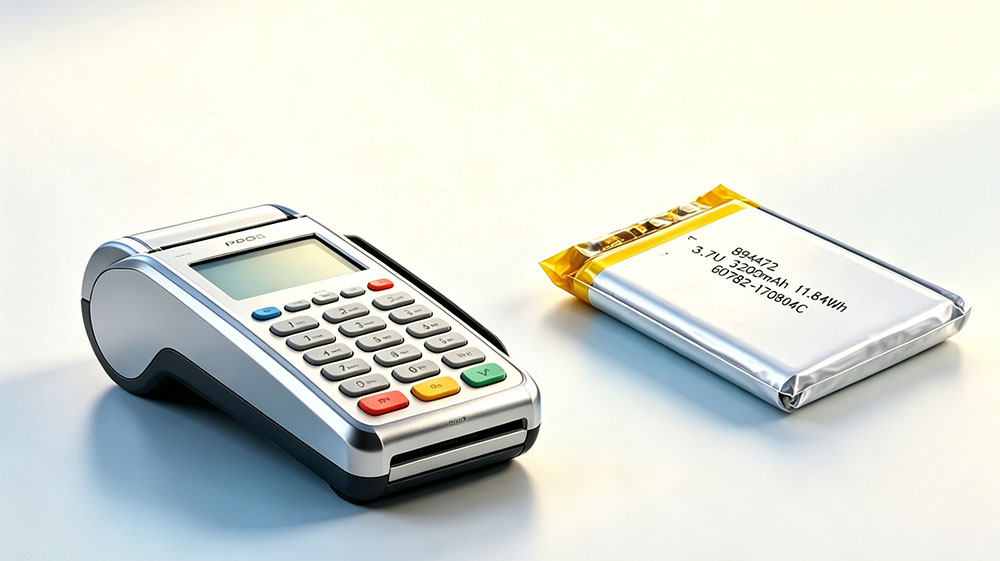
A POS machine battery is a rechargeable power source designed to supply stable energy to portable or fixed point-of-sale terminals. Unlike traditional desktop payment systems, modern POS devices frequently operate wirelessly and require dependable battery power throughout long business hours.
A typical POS machine battery powers:
Mobile POS terminals
Handheld payment devices
Smart POS systems
Portable checkout equipment
Restaurant ordering terminals
Wireless card readers
Most modern POS systems utilize lithium-ion (Li-ion) or lithium polymer (Li-Po) batteries because they offer higher energy density and longer operating time compared with older battery technologies.
The most common POS machine batteries are lithium-ion and lithium polymer batteries due to their high efficiency, lightweight design, and rechargeability. Different POS applications require different battery configurations.
| Battery Type | Energy Density | Weight | Cycle Life | Typical POS Application |
|---|---|---|---|---|
| Li-ion Battery | High | Medium | 500-1000 cycles | Standard POS terminals |
| Li-Po Battery | Very High | Light | 500-800 cycles | Slim handheld POS devices |
| NiMH Battery | Medium | Heavy | 300-500 cycles | Legacy POS equipment |
According to battery industry data, lithium-based batteries typically provide up to 250 Wh/kg energy density, significantly outperforming older nickel-based technologies. For manufacturers seeking customized battery packs, BPI Battery offers both Li-ion and Li-Po battery solutions tailored to specific POS device requirements.
Choosing the right POS machine battery requires balancing runtime, safety, charging speed, and device compatibility.
Battery selection should be based on actual operational requirements rather than capacity alone.
Several important factors should be evaluated.
Battery capacity determines how long a POS terminal can operate before recharging.
Typical handheld POS terminals use batteries ranging from:
2000mAh
3000mAh
5000mAh
6000mAh
For example, a 5000mAh battery may support 8-16 hours of operation depending on screen brightness, wireless communication, and transaction volume.
Most POS systems operate on:
3.7V
7.4V
11.1V
Incorrect voltage selection may affect performance or damage the device.
Quality POS batteries should include:
Overcharge protection
Over-discharge protection
Short-circuit protection
Temperature protection
Manufacturers should ensure batteries comply with:
UN38.3
IEC 62133
CE
RoHS
POS machine battery failures are often caused by improper charging, aging cells, or poor battery management systems (BMS).
Businesses frequently encounter issues such as:
| Problem | Cause | Solution |
|---|---|---|
| Short runtime | Battery aging | Replace battery pack |
| Slow charging | Charger mismatch | Use approved charger |
| Unexpected shutdown | Voltage drop | Upgrade battery capacity |
| Battery swelling | Excessive heat | Replace immediately |
| Reduced cycle life | Frequent deep discharge | Improve charging habits |
Industry studies indicate that maintaining charge levels between 20% and 80% can significantly extend lithium battery lifespan.
For battery safety guidance, manufacturers can reference: https://www.ul.com
Custom POS machine batteries allow device manufacturers to optimize performance, dimensions, runtime, and safety for specific applications. As POS systems become more compact and multifunctional, off-the-shelf batteries often fail to meet performance requirements.
Custom battery solutions can provide:
Higher capacity within limited space
Improved thermal management
Faster charging capability
Better connector compatibility
Enhanced battery management systems
BPI Battery specializes in OEM and ODM battery development for POS manufacturers worldwide. From battery cell selection to pack assembly and certification support, BPI helps customers accelerate product development and reduce time to market.
POS machine batteries play a vital role in ensuring reliable transaction processing, mobility, and operational efficiency. As payment technologies continue evolving, battery performance has become a key factor influencing device competitiveness.
Modern POS manufacturers increasingly prefer lithium-ion and lithium polymer solutions because they deliver longer runtime, higher energy density, and improved safety. Choosing the right battery requires careful evaluation of capacity, voltage, certifications, and application requirements.
As a professional battery manufacturer, BPI Battery provides custom POS machine battery solutions that help global customers improve product reliability, user experience, and market competitiveness. Whether you need a standard replacement battery or a fully customized battery pack, partnering with an experienced supplier can significantly improve your product's long-term success.
Most modern POS machines use lithium-ion or lithium polymer batteries because they offer high energy density, lightweight construction, and long cycle life.
A quality POS battery typically lasts between 500 and 1,000 charge cycles, which often equals 2 to 4 years of normal use.
Most handheld POS devices use batteries ranging from 3000mAh to 6000mAh depending on required operating time.
Yes. Battery manufacturers can customize voltage, capacity, dimensions, connectors, and protection circuits to match specific device requirements.
Avoid complete discharge, prevent overheating, and use approved charging equipment to maximize battery life.
Lithium polymer batteries offer greater design flexibility and lighter weight, while lithium-ion batteries often provide slightly lower cost and excellent performance.