In the European and American golf cart markets, an increasing number of users are upgrading from traditional lead‑acid batteries to lithium iron phosphate (LiFePO4) batteries. One of the core reasons is the significant difference in cycle life. Industry data shows that ordinary lead‑acid golf cart batteries typically have a cycle life of only 300 to 500 cycles, while LiFePO4 batteries generally achieve 3,000 to 5,000 cycles at 80% DOD (Depth of Discharge), with some high‑quality systems exceeding 6,000 cycles.
However, in practical use, many users find that even with the same specification “48V 100Ah LiFePO4”, the actual service life varies greatly between brands. Some batteries show obvious capacity degradation within two to three years, while others remain stable even under high‑frequency use. What truly determines cycle life is not just the “capacity parameter”, but cell consistency, BMS management system, thermal management capability and PACK manufacturing process.
As a lithium battery manufacturer dedicated to production, BPI Battery Factory has observed that cell consistency has a profound impact on cycle life. If cells from different batches and with varying internal resistances are mixed within a battery pack, voltage differences and localized heating tend to occur during high‑rate charging and discharging, accelerating capacity degradation over time. During production, BPI conducts multi‑stage screening and matching of every cell based on capacity, voltage and internal resistance, reducing the risk of pack imbalance from the source and enhancing long‑term cycling stability.
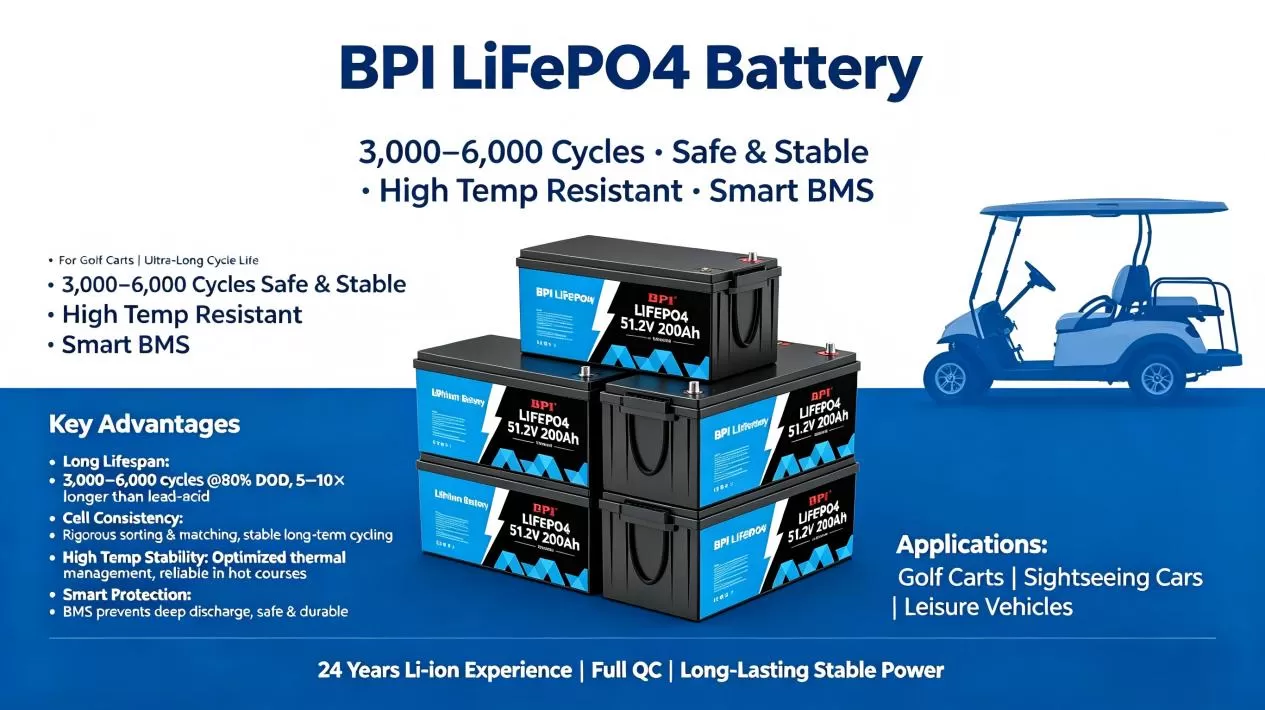
DOD (Depth of Discharge) also directly affects golf cart battery life. Industry test data indicates that when LiFePO4 batteries operate continuously at 80% DOD, their cycle life typically reaches around 4,000 cycles; if limited to 50% DOD, cycle count can increase to over 4,500–6,000 cycles. Therefore, BPI optimizes SOC management logic in BMS design to avoid excessive cell wear caused by prolonged deep discharge.
Temperature is another critical factor affecting lifespan. Research data shows that the life of lithium batteries may decrease by approximately 25% when operated continuously above 35°C. Golf carts usually run on hot courses, coastal scenic areas or under prolonged direct sunlight, making thermal management design especially important. In structural design, BPI optimizes heat dissipation paths, wiring layout and MOS temperature rise control, while offering high/low‑temperature protection solutions tailored for European and American markets, enhancing battery stability in complex environments.
In addition, charging rate has a significant impact on lifespan. Data shows that long‑term fast charging exceeding 1C accelerates cell aging and increases BMS load; controlling charging within 0.5C–0.7C is more conducive to extending battery life. BPI recommends using dedicated LiFePO4 chargers for golf cart systems, with a smart BMS monitoring charge/discharge status in real time to reduce the impact of abnormal operating conditions on the battery.