In wearable heating systems such as smart heated clothing and outdoor thermal gear, the power source is the core factor determining product experience and market competitiveness. From extreme cold outdoors to daily close‑fitting enclosed scenarios, a high‑performance, customizable lithium‑polymer battery directly defines the heating efficiency, battery life, safety level, and wearing comfort of heated clothing. BPI’s customized lithium‑polymer battery solutions designed exclusively for heated clothing, with mature technical systems and flexible customization capabilities, have become the preferred power solution for high‑end heated clothing.
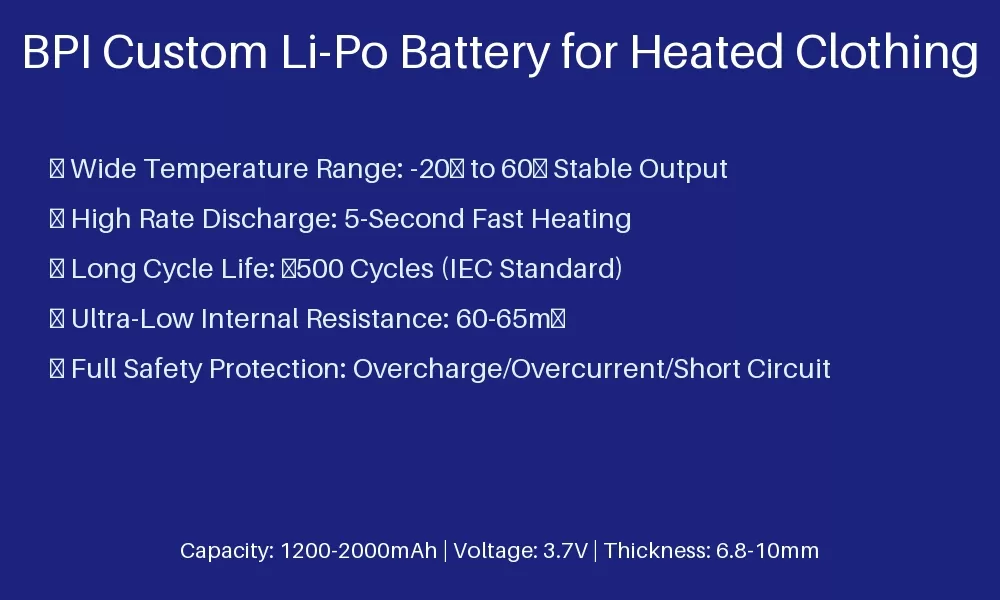
The core application scenarios of heated clothing focus on low‑temperature outdoors, making low‑temperature adaptability of the battery a key technical point. Through cell material system optimization and protection circuit iteration, BPI customized lithium batteries maintain stable discharge at an extreme low temperature of -20℃, effectively solving industry pain points such as low‑temperature activity attenuation and power‑on shutdown of ordinary batteries. Meanwhile, they adapt to the 60℃ close‑fitting enclosed environment, reducing risks of high‑temperature swelling and leakage, achieving stable power supply in all scenarios from extreme cold outdoors to daily commuting, so that warmth is not limited by the environment.
The dual demands of "instant heating + long‑lasting warmth" for high‑end heated clothing put extreme requirements on battery performance:
High‑rate discharge capability: All cells support high‑rate instantaneous discharge, enabling 5‑second rapid heating to quickly dispel severe cold without long waiting, meeting users’ core demand for instant warmth.
High energy density design: Achieve a capacity range of 1200mAh to 2000mAh and above in a limited volume, matched with a rated voltage of 3.7V, providing 6‑8 hours of continuous heating for heated clothing, adapting to all‑day outdoor work and travel needs, balancing instantaneous experience and long‑lasting battery life.
The internal resistance and cycle life of the battery directly determine the long‑term use stability of the product and the user life cycle cost:
Ultra‑low initial internal resistance: The initial internal resistance of core models is as low as 60‑65mΩ, greatly reducing discharge loss, improving energy utilization efficiency, optimizing heating control, and enhancing the safety of close‑fitting use.
IEC standard long cycle life: All series pass IEC standard tests with a cycle life of ≥500 times, meeting the needs of frequent use of heated clothing for many years, reducing user replacement costs, and conforming to the durability positioning of high‑end products.
According to the structural design, power demand and wearing experience of different heated clothing, BPI provides highly flexible customized solutions:
Size and capacity customization: Covering ultra‑thin lightweight to high‑capacity multi‑specifications, thickness can be flexibly adjusted from 6.8mm to 10mm and above, capacity covers the full range of 1200mAh‑2000mAh, which can be accurately matched according to the internal space and battery life demand of heated clothing.
Structure and interface customization: Support personalized customization of pouch structure, wire outlet direction, wire length and interface type, which can be seamlessly embedded in clothing pockets and interlayers without damaging the clothing version, realizing "invisible warmth".
Safety is a non‑negotiable core indicator for close‑fitting heated clothing. BPI customized lithium batteries integrate five protection mechanisms: overcharge, over‑discharge, short circuit, overcurrent and low temperature, realizing full‑process safety control from cells to protection boards. The pouch cell structure matched with a stable chemical system features mild failure modes, greatly reducing extreme safety risks and complying with the high safety standards of close‑fitting wearable products.
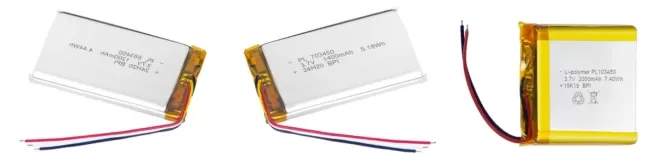
| Product Model | Dimensions (mm) | Rated Voltage (V) | Capacity (mAh) | Initial Internal Resistance (mΩ) | IEC Cycle Life (cycles) |
|---|---|---|---|---|---|
| 683450-1200 | 6.8*34*50 | 3.7 | 1200 | 65 | 500 |
| 703450-1400 | 7.0*34*50 | 3.7 | 1400 | 65 | 500 |
| 103450-2000 | 10*34*50 | 3.7 | 2000 | 60 | 500 |