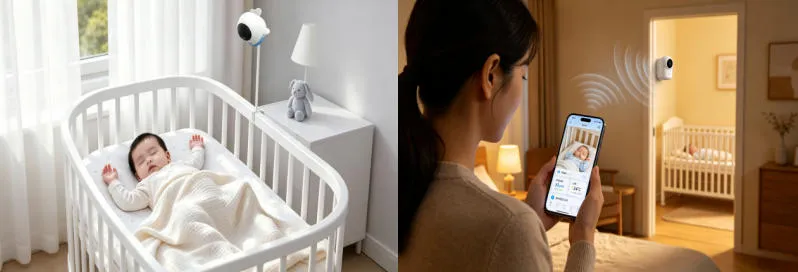
A baby monitor, also known as an infant monitor or baby surveillance device, is a wireless home security system used for remotely watching over infants and toddlers. It typically consists of two components: the monitoring unit (baby side) and the control unit (parent side). During use, the monitoring unit—equipped with a camera, microphone, and infrared sensor—is placed in the baby's room to collect real-time video, audio, and environmental data. These signals are transmitted to the parent-held control unit (such as a portable display or smartphone app) via wireless technologies including radio waves or Wi-Fi, where they are decoded and restored into images and sound. This allows parents to keep track of their baby's every move at all times, even from another room or outdoors. Modern baby monitors have evolved from early pure-audio monitoring into intelligent devices integrating high-definition video, infrared night vision, cry detection, two-way talk, temperature and humidity monitoring, motion detection alerts, and more. Some premium products have also introduced AI analysis, breathing monitoring, and other intelligent features.
Whether a baby monitor "has enough battery to last an entire night," "whether its runtime collapses after six months," or "whether it is safe while charging" often depends on the critical polymer lithium battery concealed within the chassis that charges and discharges day and night.
In recent years, with the relaxation of two-child and three-child policies, the awakening of scientific parenting awareness among new-generation parents, and breakthroughs in wireless communication and AI vision technology, baby monitors are transitioning from a luxury for a few high-end families to a standard parenting essential for thousands of households. In newborn care scenarios, it helps new parents keep track of their baby's sleep and safety conditions at all times. In daily childcare routines, it allows mothers to stay informed about their baby's every move while cooking, bathing, or handling household chores. When the baby enters the independent room-sleeping stage, it becomes an important bridge to alleviate parental separation anxiety and cultivate the baby's independence. Baby monitors are no longer merely electronic devices that transmit sound and images; they are becoming parenting companions that connect parents with their babies and safeguard security and peace of mind.
Against this backdrop, the power system is not only a source of energy but also the core of product reliability and user experience. The industry's key concern is not how high the camera resolution is or how flashy the AI features are, but whether it remains stable and reliable at critical moments—when parents are drowsy late at night, can the monitor continue working through the entire night without suddenly shutting down at 3 a.m.? When the baby is in the transition period of independent room sleeping and parents are extra sensitive to every turn and every cry, can the video transmission remain real-time and smooth without delay or disconnection? When the device needs to operate 24/7 with daily frequent charge and discharge cycles, can the battery's cycle life withstand the test without its runtime being cut in half after six months of use? Under long-term charge and discharge operating conditions, is the battery's internal structure safe and controllable, without overheating or swelling?
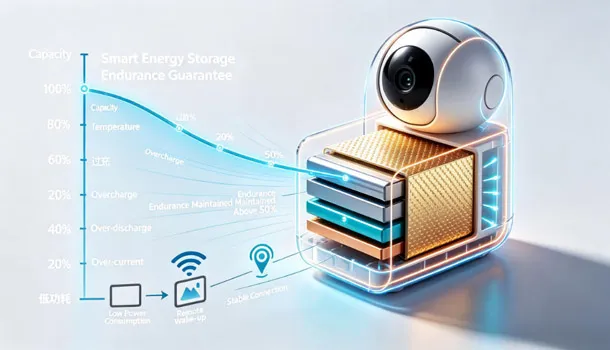
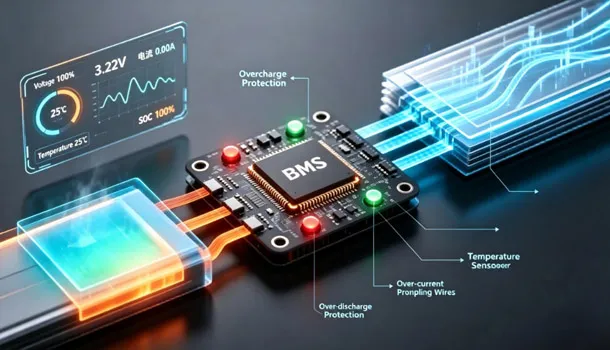
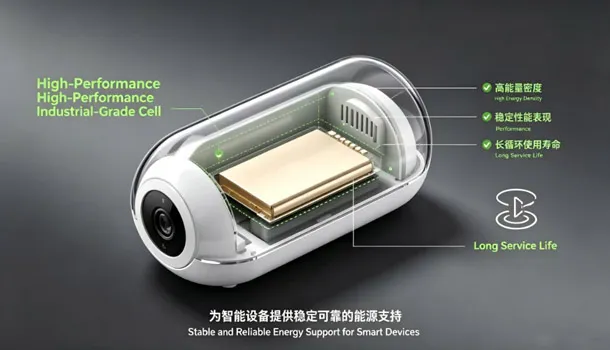
This has directly driven baby monitor batteries to evolve from ordinary consumer-grade cells toward high energy density, long cycle life, multiple safety protections, and low self-discharge. Therefore, in baby monitors—a device closely related to infant safety that requires 7×24 uninterrupted operation—the battery's runtime endurance, cycle stability, and safety reliability have become the foundation that determines whether a product can truly impress consumers and advance into the premium market.
This imposes far more stringent technical requirements on the battery than ordinary consumer electronics, mainly reflected in the following four aspects:
● Continuous and stable power supply: The device is on standby 24/7, and every wake-up requires the battery to respond instantly without voltage sag causing restart or lag. The battery must feature high energy density (large capacity in a small volume) and low internal resistance (stable voltage without sag during high-current output), ensuring that a single charge is sufficient to support an entire night of care.
● Long cycle life: The parent unit is charged whenever used, with frequent plugging and unplugging, keeping the battery in a constant charge and discharge state. The battery must support a cycle life of 500 or more cycles (80% capacity retention), ensuring that no obvious runtime degradation occurs after six months or one year of use.
● Multiple safety protections: In parenting scenarios, battery overcharge, over-discharge, or short circuits may cause heating and swelling, directly endangering infant and toddler safety. The battery must have a built-in intelligent protection board with overcharge, over-discharge, and short-circuit triple protection mechanisms to eliminate safety hazards at the source.
● Customized space adaptation: The interior space of handheld devices is extremely limited, and standard-size batteries cannot fit. The battery must adopt polymer pouch cells, supporting full customization of dimensions, capacity, voltage, protection board, and cable connectors to perfectly embed into compact chassis designs.
Among various battery technology routes, polymer batteries, with their comprehensive performance advantages, have become the mainstream power solution for baby monitors. The reason is that they perfectly align with the core needs of baby monitors:
| Core Requirement | Polymer Lithium Battery Solution |
| Long-lasting Endurance | Adopts high energy density lithium cobalt oxide system (550Wh/L), fully charged to support 8-10 hours of real-time monitoring, covering an entire night of care needs; low internal resistance design (≤50mΩ) ensures stable voltage without sag, eliminating the embarrassment of midnight power loss. |
| Slim and Lightweight Adaptation | Adopts soft-pack polymer cells, with thickness, width, and length flexibly customizable according to the device's internal space, perfectly embedding into the compact chassis of baby monitors without wasting space or adding weight burden. |
| Long Cycle Life | Premium polymer cells maintain over 80% capacity retention after more than 500 deep charge and discharge cycles, covering a complete 2-3 year usage cycle without requiring frequent battery replacement or factory repair. |
| Intelligent BMS Management | Paired with a precision battery management system (BMS), achieving real-time monitoring of voltage, current, and temperature, providing multiple hardware-level protections including overcharge, over-discharge, overcurrent, and short circuit. |
Founded in 2002, BPI has its headquarters in Shenzhen and a wholly-owned 200-acre intelligent manufacturing base in Yichun, Jiangxi. It is a national high-tech enterprise integrating R&D, production, and sales of lithium batteries, nickel batteries, battery packs, and energy storage products, with annual revenue exceeding 500 million RMB. Its daily production capacity for nickel-metal hydride and lithium batteries reaches 800,000 units, with products sold to over 80 countries worldwide. The company has long been deeply engaged in OEM/ODM supporting for international brands. Holding more than 130 core battery patents, its technologies in high-temperature explosion prevention, long-term low self-discharge, and nickel-zinc batteries lead the industry. It has established industry-university-research bases with Tsinghua University and Tianjin University, combining automated production lines, global distribution channels, independent innovation technology, and standardized enterprise management. It is a comprehensive battery solution provider with production capacity, technical strength, and safety capabilities.

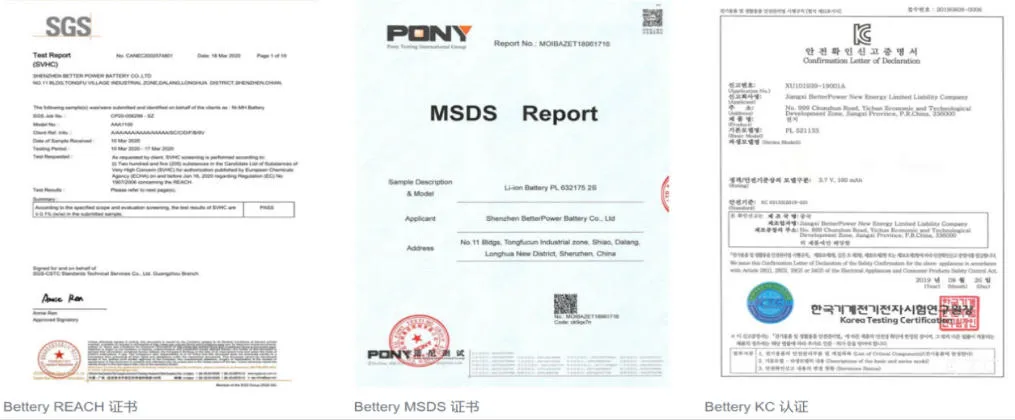
BPI lithium batteries cover both high energy density systems and standard rate systems, and can be combined and custom-developed for different product forms of baby monitors. Among them, the high energy density series and intelligent protection board solutions have been widely used in parenting care devices with extremely high requirements for runtime, safety, and reliability. At the product design stage, BPI is already application-scenario-oriented—targeting the two core demands of all-night continuous care and frequent charge and discharge in parenting scenarios, with specialized optimization in cell materials and formulations. It adopts a high energy density lithium cobalt oxide system to provide greater capacity in the same volume, fully charged to support 8-10 hours of continuous real-time video monitoring, covering an entire night of care needs. By optimizing electrode structure and electrolyte formulation, cycle stability is significantly improved, maintaining over 80% capacity retention after more than 500 deep charge and discharge cycles, ensuring that the device's long-term runtime does not collapse and performance does not degrade.
Ordinary digital device cells are primarily designed for short-term use devices such as smartphones and power banks, with narrow charge and discharge windows and relatively low cycle life standards. When used in baby monitors that operate 24/7 uninterrupted with frequent charge and discharge cycles, when users simultaneously enable video monitoring, Wi-Fi transmission, infrared night vision, and AI cry detection, power consumption instantly surges, battery voltage drops significantly, and the device frequently lags or even shuts down automatically. Cells operating long-term under high-depth charge and discharge conditions experience rapid cycle life degradation—when newly launched, runtime is acceptable, but after 3-6 months, user negative reviews concentrate: "After less than half a year, the runtime is only half left."
Many brand owners' battery testing is limited to how long the new device lasts on a full charge, and the test environment is ideal laboratory conditions. However, real-world user scenarios are far more complex: weak Wi-Fi signals increase power consumption, nighttime infrared night vision plus always-on screen stacking high power consumption, and frequent transitions between standby and wake states. More critically, these issues often only concentrate and expose after battery cycle aging—initial runtime 10 hours, 6 hours left after three months, and cannot even last an entire night after half a year. Brand owners lack mandatory assessment for cycle life (≥80% capacity retention after 500 cycles), and have not verified user experience details such as low battery warning accuracy and fast charge compatibility.
In advanced intelligent care devices, the truly critical components are often not glamorous. This is true for baby monitors, and so is the internal power battery.
BPI polymer lithium batteries continuously deliver value in these invisible yet experience- and safety-critical core positions through stable, reliable, predictable, and inherently safe performance. It not only provides persistent, uninterrupted power support for the device—fully charged to guard an entire night (8-10 hours of continuous video monitoring)—but also, through stringent quality control, ensures that capacity retention remains above 80% after more than 500 deep charge and discharge cycles, keeping the device as stable as a rock through years of frequent charge and discharge cycles with undiminished guardianship. The built-in intelligent protection board works in coordination with NTC thermistors to cut off abnormal risks such as overcharge, over-discharge, short circuit, and overheating at the millisecond level, making every interaction between parents and babies more reassuring and every night's sleep more sound.
In parenting care device applications, the battery is never a simple energy storage component but a core component of the entire machine's safety and reliability system. BPI always adheres to strict standards as the fundamental criterion for product development and manufacturing, with full-process traceability and controllability. Over a 2-3 year usage cycle, performance changes are predictable, risks are controllable, and quality is guaranteed.
Baby monitor batteries—choose runtime, choose safety, choose BPI!
Q: Is the battery safe? Will it swell or overheat when plugged in for long periods?
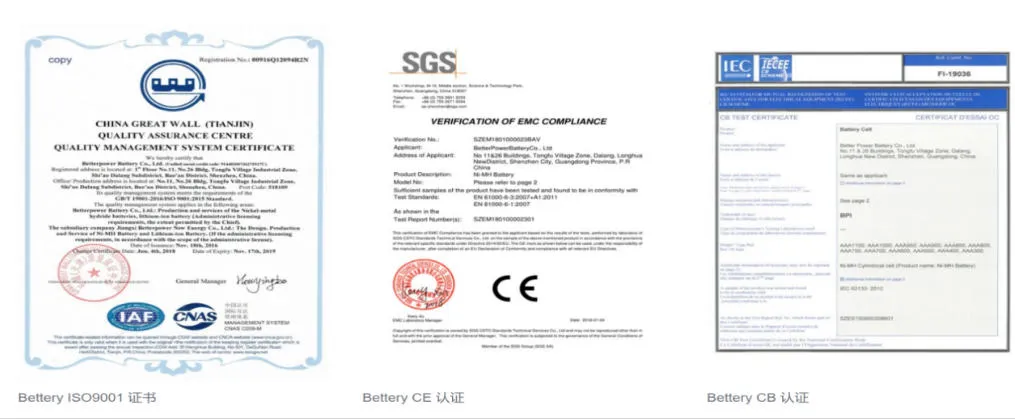
A: Safe and reliable. BPI batteries have passed mainstream global safety certifications including UL, CE, RoHS, UN38.3, and KC, strictly benchmarking against UL1642 standards. Built-in hardware protection boards and NTC thermistors can cut off circuits at the millisecond level when overcharge, over-discharge, short circuit, or overheating abnormalities occur. The soft-pack aluminum laminate film encapsulation only swells to release pressure without rigid explosion, providing dual protection—making devices used close to infants and toddlers completely reassuring.
Q: Does the battery have a memory effect? Must it be fully discharged before charging?
A: No memory effect. BPI polymer lithium batteries differ from old-style nickel-metal hydride or nickel-cadmium batteries and do not require fully discharging before charging. Charge and use as needed; frequent deep discharge will instead accelerate electrode material fatigue. Users can simply follow normal usage habits for charging—intermittent daytime topping up, fully charged nighttime care—without affecting battery life.**