An auto-injector is an intelligent medical device that integrates drug storage, automatic drive, and precision injection. Compared with traditional manual injection methods, auto-injectors help patients complete more stable and convenient drug administration processes, widely used in diabetes, autoimmune diseases, allergy emergency treatment, and home medical care scenarios.
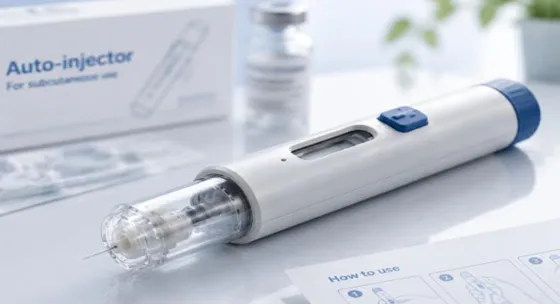
For patients, an auto-injector is merely a compact and portable medical device; but for manufacturers, the hidden power system inside determines whether the device can operate precisely, trigger safely, and remain reliable over the long term.
A single precise injection depends not only on mechanical structure and control systems but, more fundamentally, on a stable and reliable battery as the core power source.
With the development of home healthcare and precision medicine, auto-injectors are evolving from simple auxiliary injection tools toward more intelligent and portable medical equipment.
Traditional injection methods rely on manual completion of the push process, easily affected by operating force, speed, and patient experience. Auto-injectors automate the drug release process through motor drive, sensor control, and precision mechanical structures, improving convenience and consistency of use.
However, simultaneously, auto-injectors impose stricter requirements on the internal battery system:
● Instantaneous High-Power Output Demand: When an auto-injector starts, it needs to drive a micro-motor or actuator to rapidly complete the plunger action. The battery must possess excellent rate discharge capability, providing stable current instantaneously to avoid problems such as insufficient power or sluggish action.
● Long-Term Storage Stability Requirements: Unlike ordinary consumer electronics, some auto-injectors require relatively long standby storage. The battery needs low self-discharge characteristics and excellent long-term stability to ensure normal activation at critical moments.
● Miniaturization and Lightweight Design: Auto-injectors typically need to satisfy portable usage requirements with limited internal space. The battery must provide sufficient energy while also balancing volume, weight, and structural adaptation.
● Medical-Grade Safety Requirements: Since auto-injectors directly relate to human drug administration safety, the battery must possess comprehensive safety protection design to avoid risks of overcharge, over-discharge, short circuit, and abnormal temperature rise.
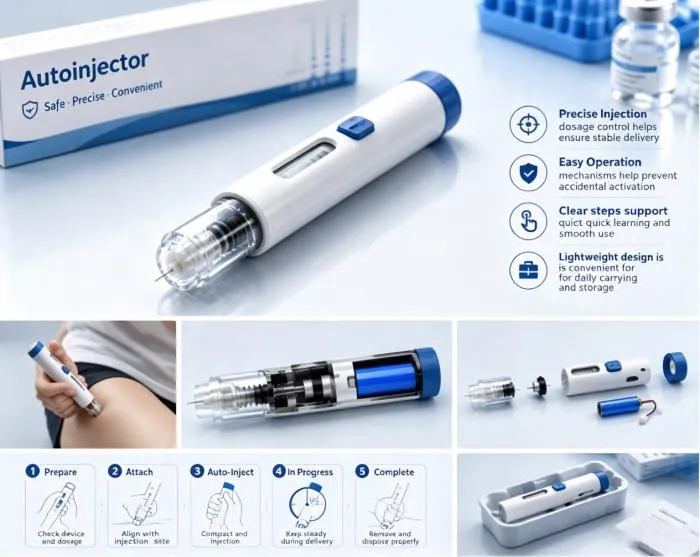
In the auto-injector system, the battery is not a simple energy storage component but an important part connecting power output, safety control, and user experience.
| Auto-Injector Core Requirement | BPI Lithium Battery Solution |
| Instantaneous High-Rate Startup | Supports 3C–5C rate discharge, providing stable large current at the moment of device startup to ensure rapid, precise, and stutter-free plunger action. |
| Long-Term Storage Reliability | Adopts a low self-discharge cell system with annual self-discharge rate controlled within 3%, remaining normally activatable after months or even more than one year of storage. |
| Small Volume, Long Endurance | Energy density as high as 150–250 Wh/kg, achieving sufficient energy reserves within compact space, supporting multiple injection cycles or long-term standby. |
| Medical-Grade Safety Assurance | Integrates a high-precision protection circuit module (PCM), achieving four-layer hardware-level protection of overcharge, over-discharge, short-circuit, and over-temperature, ensuring safety throughout the full device lifecycle. |
As an enterprise focused on battery R&D and manufacturing, BPI continuously optimizes battery product design around high-reliability application scenarios such as medical equipment and intelligent terminals, providing customers with stable, safe, and highly adaptable power solutions.
Addressing the product characteristics of auto-injectors, BPI can conduct customized development according to device structure, voltage platform, and usage requirements.
During the product design phase, BPI focuses on:
● High-Consistency Cell Management: Through strict control of cell performance variation, improving the long-term operational stability of battery packs and reducing performance degradation caused by individual cell differences.
● Intelligent Protection Solutions: Combining protection circuit modules (PCM) or intelligent Battery Management Systems (BMS) to achieve multi-dimensional monitoring of voltage, current, temperature, and other parameters, improving usage safety.
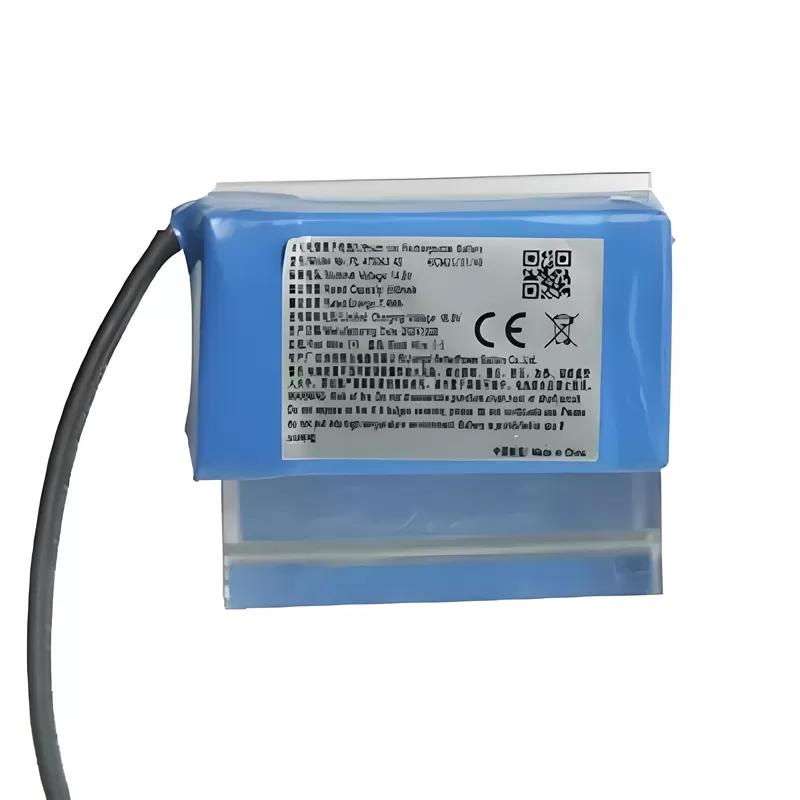
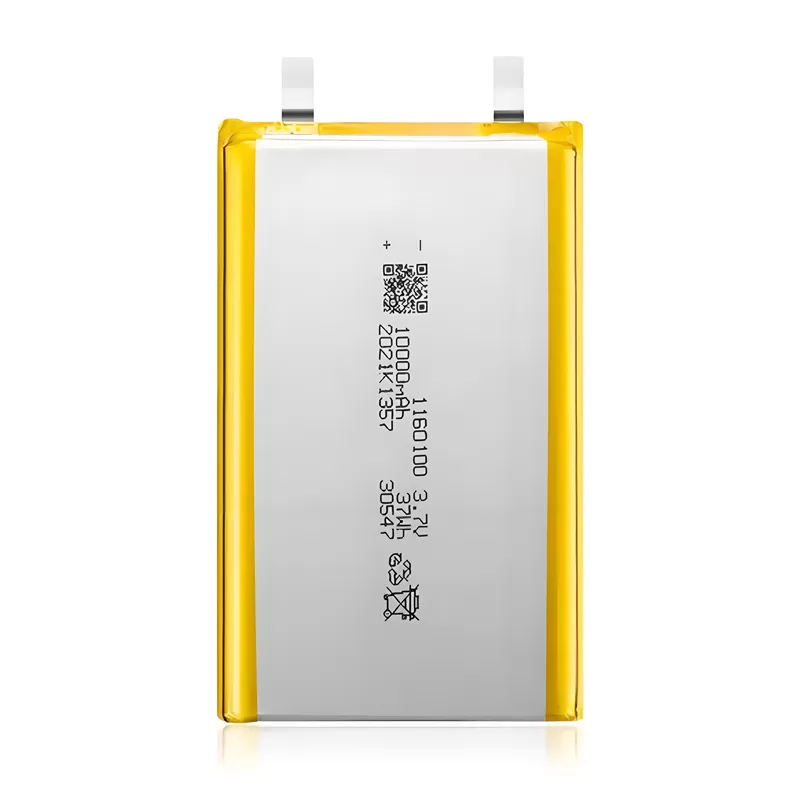
● Structural Customization Capability: Addressing the internal space constraints of auto-injectors, providing customized solutions with different dimensions, capacities, and voltage platforms to meet the lightweight and miniaturization needs of medical devices.
● Strict Quality Control: From cell screening, manufacturing processes to finished product testing, achieving full-process quality control to ensure stable performance in medical application scenarios.
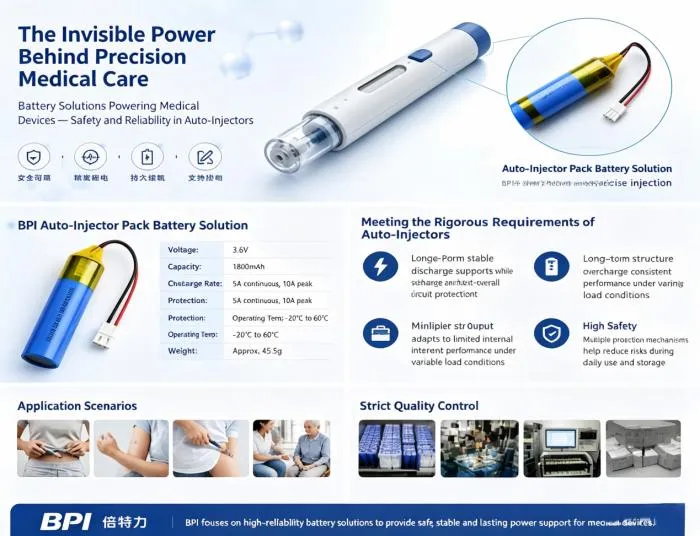
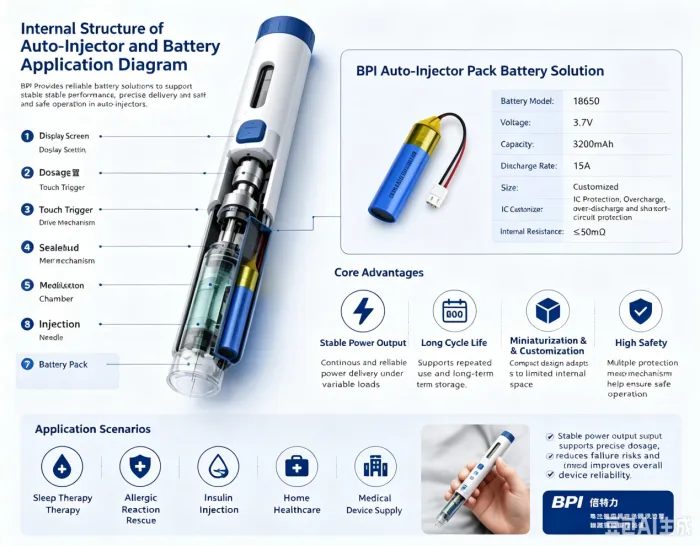
Some products, seeking to reduce costs, select ordinary cells commonly used in digital devices and power banks—devices with weak current requirements. However, auto-injectors require driving a load and outputting relatively large current at the moment of startup. When facing this pulse discharge demand, ordinary batteries may experience voltage sag, insufficient power, or even system freeze, leading to interrupted injection action or abnormal push speed—something absolutely unacceptable in drug administration scenarios.
The typical usage pattern of medical devices is "long-term standby, occasional use." If the battery has a high self-discharge rate or insufficiently stable chemical system, performance may noticeably degrade after months of storage, causing the device to fail to start when truly needed. For scenarios such as allergy emergency treatment and insulin administration, this "failure at the critical moment" could be fatal.
Today, as intelligent medical devices continue to develop, auto-injectors are helping more patients achieve more convenient and safer treatment experiences.
The battery hidden inside the device determines whether the auto-injector can start stably at critical moments.
BPI consistently takes reliability, safety, and high performance as the core of product development, providing continuous power support for intelligent medical devices through professional battery technology.
For auto-injector battery solutions, choose a stable and reliable power partner—BPI.
Q: Can BPI customize batteries for auto-injectors?
A: Yes. BPI supports customized development based on product dimensions, voltage platforms, capacity requirements, and internal installation space, providing multiple structural solutions including cylindrical, flat, and irregular shapes, flexibly adapting to the assembly needs of different auto-injector models.
Q: Why do auto-injectors require high-rate batteries?
A: When an auto-injector starts, it needs to drive a micro-motor to overcome static friction and rapidly push the piston to complete drug delivery. The instantaneous current demand is far higher than the standby state. High-rate batteries can provide stable large-current output, ensuring rapid, precise, and stutter-free plunger action, guaranteeing that the drug solution is injected into the human body at the designed speed.
Q: What are the advantages of BPI medical device batteries?
A: BPI possesses capabilities in cell grading and matching, protection board solution design, irregular structure customization, and full-process quality control, providing safe, stable, and highly adaptable customized power solutions for medical devices.