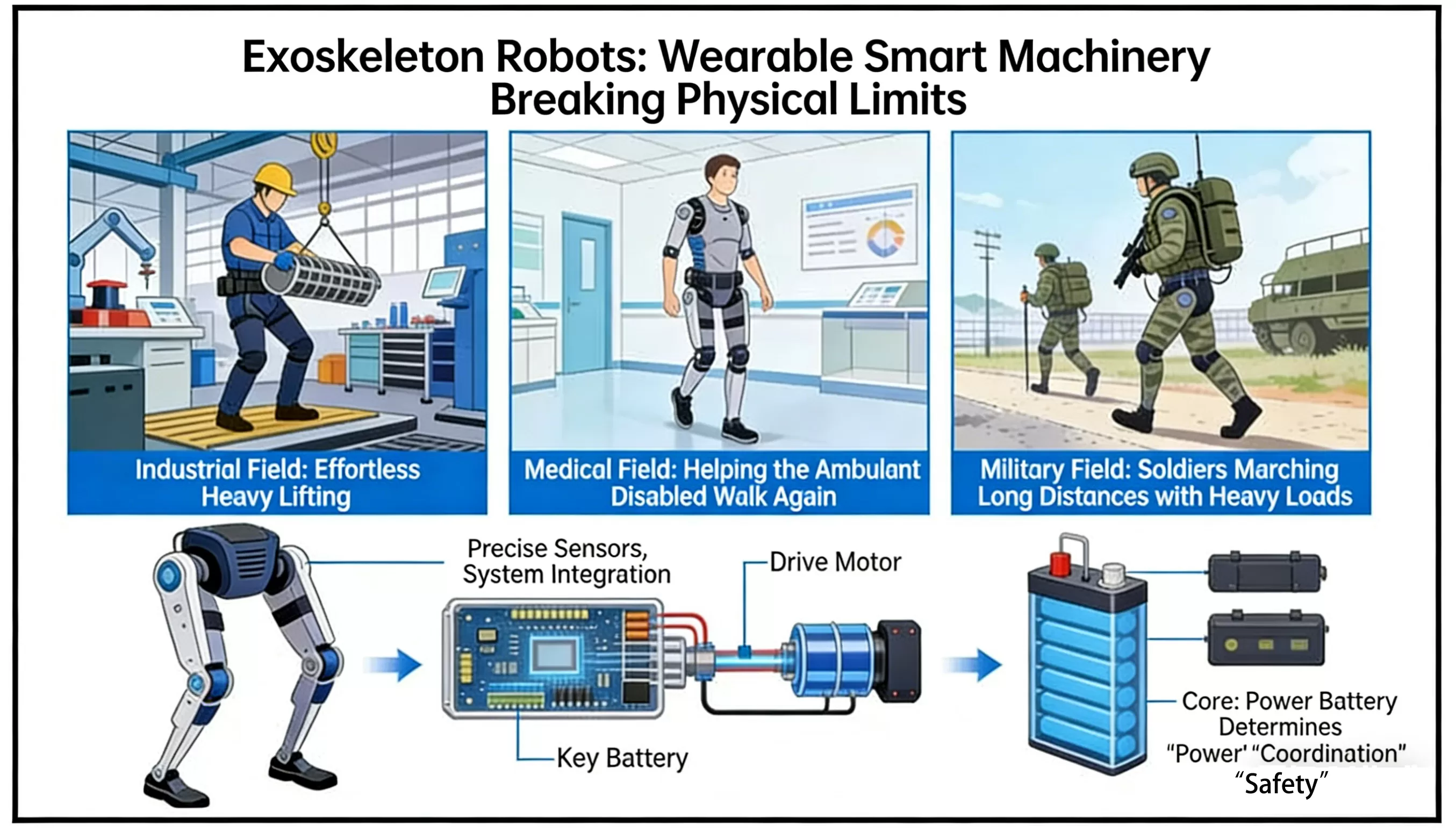
An exoskeleton robot is an intelligent mechanical device worn on the human body. It can be understood as a wearable robot that enhances human function. In industrial, medical, military, and civilian assistive fields, exoskeleton robots are responsible for enabling humans to "break through physical limits." Through sophisticated sensors, control systems, and drive motors, it senses the human body's intentions in real time and outputs auxiliary power, making it easier to lift heavy objects, allowing those with walking difficulties to take their first steps again, and enabling soldiers to carry heavy loads on long marches. The paralyzed patients you see in the news standing and walking with the help of devices, and factory workers easily lifting tens of kilograms of parts, all rely on the "central nervous system" and "muscular system" of exoskeleton robots. The strength, coordination, and safety of an exoskeleton often depend on the key power battery that drives its core joints and control system.
In recent years, with the increasing aging of the global population, the evolution of industrial automation towards human-machine collaboration, and the explosive growth in demand for rehabilitation medicine, exoskeleton robots are moving from the laboratory to large-scale applications. In the industrial sector, they are used to reduce worker injuries and improve productivity; in the medical rehabilitation field, they assist patients with nerve damage in reconstructive training; in the military field, they enable soldiers to carry heavy loads and move at higher speeds. Exoskeletons are no longer just a science fiction concept, but are becoming important equipment for improving human quality of life and work efficiency.
Against this backdrop, the power system of exoskeleton robots is not only a reflection of technological advancement but also the core of application reliability and user safety. The industry's focus is not on the motor's power output, but on its stability and reliability in critical moments—can the power be delivered smoothly when the user is squatting under load, climbing slopes, or undergoing rehabilitation training? Can the battery sustain operation for several hours continuously? Is the battery safe and controllable when exposed to impacts or extreme temperatures?
This has directly driven the evolution of exoskeleton power batteries from "meeting basic battery life" to "high energy density, high power output, and absolute safety." Therefore, in exoskeleton robots, a system deeply coupled with the human body, battery safety, stability, and predictability have become crucial foundations for the product's successful practical application.
In exoskeleton robot systems, the battery isn't a "cool" component. It doesn't directly generate power or participate in algorithmic decisions, yet it's present throughout almost the entire lifecycle of the device, from manufacturing and daily use to emergency protection. How long the device can operate continuously, the smoothness of its assistance, and its ability to safely shut down to protect the user in emergencies largely depend on the battery system's ability to provide a stable power supply.
For this reason, exoskeleton robots impose extremely stringent design requirements on their batteries: they must provide enough energy to support several hours of continuous use within a limited weight, deliver powerful peak power during start-up, climbing, and carrying heavy loads, and simultaneously ensure user safety under all circumstances.
When the device experiences severe shaking, external impact, or operates in extreme temperature environments, its internal battery system must maintain stable voltage and smooth output, without sudden power loss or performance degradation. This means that exoskeleton robots must have a high-energy-density, high-power-density, and highly safe intelligent lithium battery system.
This battery, which provides the "lifeblood" for the steel skeleton, is often far more important than imagined.
From a usage perspective, exoskeleton robot batteries need to support high-power discharge during intensive work (peak power up to 1-2kW) while maintaining long-lasting battery life (typically 4-8 hours or more) in standby or light assistance modes. They require frequent deep charge-discharge cycles, yet must maintain stable performance after hundreds or thousands of cycles without significant performance degradation or safety hazards.
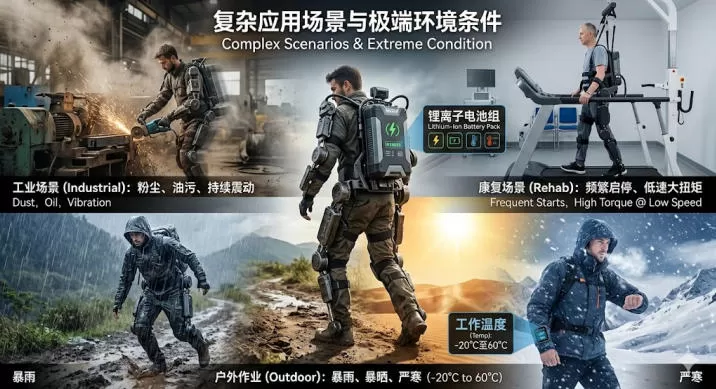
Further complicates the application scenarios and environmental conditions. Exoskeleton robots fit closely to the human body, requiring consideration of user comfort while coping with various complex environments: industrial scenarios may involve dust, oil, and continuous vibration; rehabilitation scenarios require frequent start-stop operations and low-speed, high-torque output; outdoor operations may encounter heavy rain, scorching sun, or extreme cold (operating temperature requirements range from -20℃ to 60℃). These highly dynamic operating conditions, long-term use, and close contact with the human body place extremely high demands on the battery's energy density, power characteristics, safety, and environmental adaptability.
Among various battery technologies, lithium-ion batteries have become the mainstream power solution for exoskeleton robots due to their comprehensive performance advantages. This is because they perfectly meet the core requirements of exoskeletons:
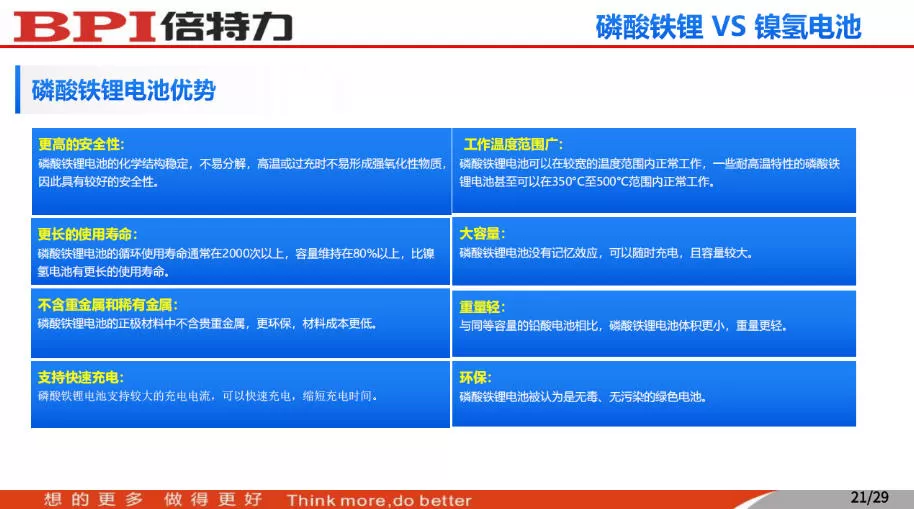
More importantly, it features human-machine safety characteristics. Considering the close-fitting nature of exoskeletons, lithium batteries achieve inherent safety through multiple protective designs: cells certified to safety standards such as UN38.3 and IEC62133 are selected; lithium iron phosphate (LFP) systems are used to further improve thermal stability; the BMS provides multiple protections against overcharge, over-discharge, overcurrent, short circuit, and over-temperature; and the structural design meets IP54-IP67 protection levels, offering vibration and impact resistance.
As a manufacturer with years of experience in the battery industry, Betterpower (BPI) has developed a complete and mature product system in the lithium battery field and accumulated rich experience in areas with extremely high reliability requirements, such as industrial equipment and intelligent equipment.
BPI lithium batteries cover multiple technology directions, including high-energy-density ternary systems, high-safety lithium iron phosphate systems, and high-rate power systems. They can be combined and customized for different application scenarios of exoskeleton robots (such as smooth assistance in medical rehabilitation, sustained output in industrial applications, and high and low temperature adaptability in military scenarios). Among them, the high-rate series and intelligent BMS solutions have been applied to various intelligent equipment systems with extremely high requirements for stability, safety, and human-machine interaction.
During the product design phase, Betterpower is application-scenario oriented, emphasizing cell consistency control, long cycle life, and multiple safety redundancy designs, rather than simply pursuing maximum capacity or peak power parameters.
In practical applications, exoskeleton robot batteries often need to undergo a lifespan of several years, during which they undergo frequent deep charge and discharge cycles without exhibiting bulging, leakage, sudden capacity drop, or safety risks. This is one of the key reasons why Betterpower lithium batteries are recognized in the field of intelligent equipment.
The stable output capability, excellent rate discharge characteristics, ultra-long cycle life, and reliable safety performance of Bettertech products in wide-temperature environments perfectly meet the core requirements of exoskeleton robots for a power source that is "continuously powerful, always available, and absolutely safe."
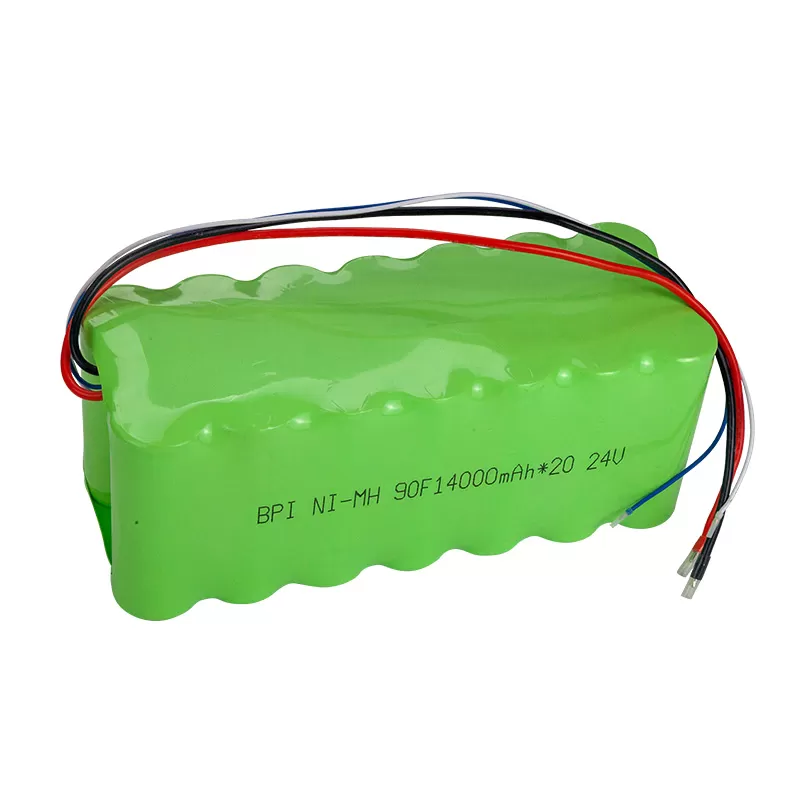
Exoskeleton robots for different application scenarios and user groups exhibit significant differences in mechanical structure, joint layout, and spatial design. Betterpower offers a variety of lithium battery specifications and customized battery pack solutions to meet different voltage platforms (e.g., 24V, 36V, 48V), capacity requirements (5-20Ah), and irregular structural designs, supporting personalized development and matching for customers.
From lightweight portable medical rehabilitation equipment (battery weight ≤2kg) to high-load industrial assistive exoskeletons (4-8 hours of battery life), Betterpower lithium batteries provide reliable and long-lasting power support for various exoskeleton robots while ensuring safety and stability.
In advanced human-machine collaborative systems, the truly critical components are often unassuming. This is true for exoskeleton robots, and it is also true for their internal power batteries.
Betterpower lithium batteries, through their stable, reliable, predictable, and inherently safe performance, continuously deliver value in these "invisible yet crucial to safety and experience" core positions, providing a solid power guarantee for exoskeleton robot systems and making human-machine collaboration more natural, safer, and more sustainable.
In intelligent equipment applications, batteries are never simply energy storage components, but rather a core component of the overall safety and reliability system. Especially in systems like exoskeleton robots, which involve deep human-machine coupling and personal safety, products must not only meet basic performance requirements but also comply with stringent industry safety standards and quality systems.
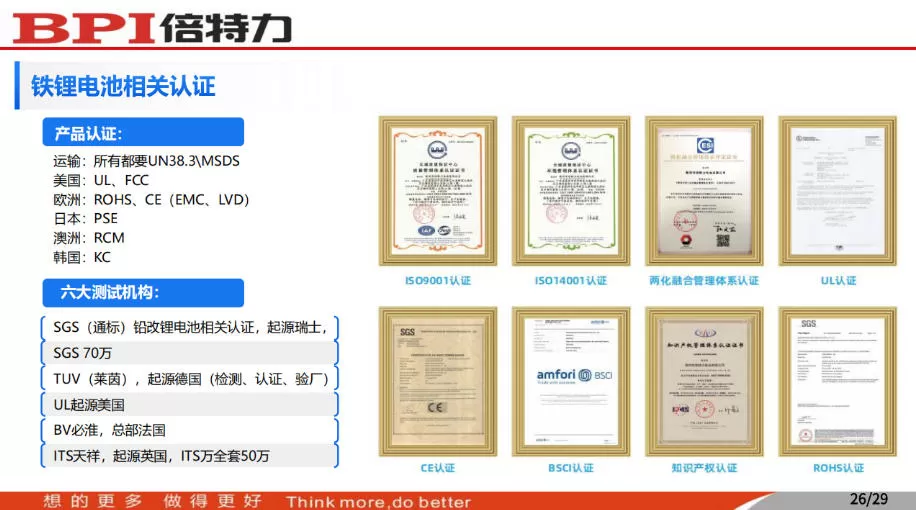
Betterpower consistently adheres to automotive-grade standards as the fundamental principle of product development and manufacturing, strictly following the core concepts of ISO 13485 (Medical Device Quality Management System) and IATF 16949 for comprehensive process control. From R&D and design, raw material management, production and manufacturing to outgoing inspection, the entire process is traceable and controllable.
Under this system, battery consistency, reliability, and long-term safety are prioritized, rather than the "extreme performance" of a single parameter. This is precisely the core value valued by exoskeleton robot customers—predictable performance changes, controllable risks, guaranteed quality, and the highest priority protection of personal safety over a multi-year usage period.
As a result, Betterpower lithium batteries can be stably used in intelligent equipment systems with extremely high reliability and safety requirements, providing long-term, reliable power support for exoskeleton robots.
For exoskeleton robot batteries, choose safety, choose reliability, choose Betterpower!