PDA, short for Portable Data Assistant, is an indispensable “mobile data brain” for logistics, warehousing, manufacturing, retail, healthcare and other industries. Through barcode scanning, RFID identification, real-time positioning and other technologies, it enables on-site data to be instantly uploaded to ERP, WMS or cloud platforms while receiving background instructions. Key processes such as real-time warehouse inventory updates, logistics tracking and inventory reports highly rely on PDAs. Whether an enterprise’s data is real-time and accurate often depends on the stability and reliability of these industrial-grade handheld terminals.
As China vigorously promotes industrial digitalization and intelligent supply chains, real-time data collection has become a basic requirement. Data accuracy, collection efficiency and abnormal response capabilities directly affect corporate competitiveness. PDAs are not just tools, but key nodes in digital transformation. Whether PDAs can operate continuously and stably under harsh conditions such as high and low temperatures, dust, drops and high-intensity work has become a core pain point.
This “mobile brain” must accurately collect and upload data in real time even during forklift collisions, outdoor exposure, cold-chain low temperatures or all-day high-frequency scanning. All of this relies on a built-in, independent, robust and long-term reliable power system — high-performance lithium-ion/lithium-polymer batteries.
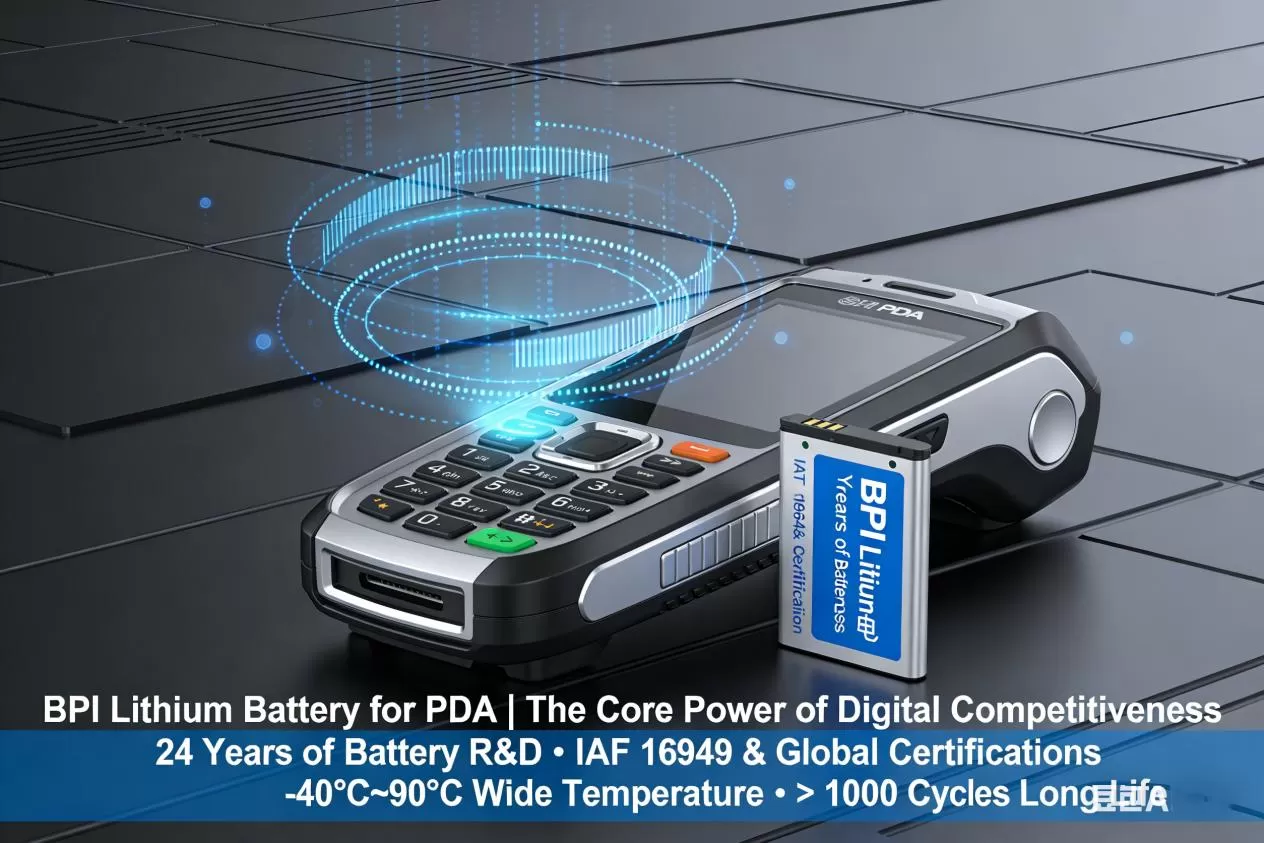
The core value of PDAs lies in providing continuous, efficient and error-free data collection in complex environments, helping enterprises reduce labor costs by 20%–40%, improve inventory accuracy to over 99% and achieve full-link traceability. What truly determines reliability is the built-in lithium-ion battery.
As the preferred power source for industrial-grade PDAs, BPI lithium-ion PDA batteries have become the trusted choice for many PDA manufacturers and end users thanks to high energy density, wide-temperature adaptability, high safety and long cycle life. With over 24 years of expertise in the battery industry, BPI is a professional manufacturer of lithium-ion batteries, PACK battery packs and energy storage solutions in China, holding the IATF 16949 quality management system and multiple international certifications such as UL and CE. Its lithium-polymer and high-performance lithium-ion batteries are specially designed for PDAs, perfectly adapting to harsh industrial scenarios and supporting flexible customized production according to customers’ specific structural and capacity requirements.
PDAs are used for long-term, high-intensity mobile operations and need to complete scanning and transmission instantly at critical moments. Ordinary consumer-grade or low-end lithium batteries have short battery life, tend to overheat and perform poorly in harsh environments, easily causing mid-operation disconnection, data loss or equipment failure.
The operating environment is more complex: PDAs often work in warehouses, factories, outdoors and cold-chain scenarios, facing temperatures ranging from dozens of degrees below zero to over 50°C, as well as dust, liquid splashing, drops above 1.5 meters and continuous vibration. Such wide-temperature, shock-resistant and low-fault-tolerance industrial scenarios impose far higher requirements on batteries than consumer electronics.
BPI lithium-ion/lithium-polymer batteries have significant advantages in this field and can flexibly adapt to various PDA structures. Below are some typical applicable models (all produced by BPI and optimized for industrial needs):
446178: High-capacity design, suitable for medium and large PDAs, supporting long-time high-frequency scanning
655814: Balances capacity and size, ideal for lightweight handheld terminals
745368: Excellent energy density, meeting all-day high-intensity operations
104050: Slim structure, for compact PDAs
504975: Outstanding wide-temperature performance, suitable for cold-chain or high-temperature environments
706070: Large-capacity, high-safety model for heavy-duty industrial scenarios
These models all feature outstanding properties:
Wide-temperature performance (-40°C to 90°C) with stable output, ensuring no power loss in winter and no overheating in summer
High energy density, supporting 8–14 hours of high-intensity operation per charge
Excellent safety with good thermal stability and mild failure modes
Low self-discharge and long cycle life (>1000 cycles), remaining stable and predictable after years of use
These advantages make PDAs “always available and reliably long-term” in extreme environments, precisely matching the stringent power requirements of enterprise digitalization.
Do not choose PDAs based only on appearance or parameters; evaluate systematically according to scenarios, focusing on the performance of the built-in battery. Follow these steps:
1. Clarify application scenarios: Choose barcode/RFID types for logistics and warehousing; explosion-proof PDAs for dangerous goods/chemical industries; lightweight models for retail/healthcare
2. Evaluate environmental adaptability: Support for wide temperature (-40°C~90°C), high protection (IP65/IP67), drop resistance (1.5m+) and explosion-proof certification
3. Focus on battery performance: Adoption of BPI high-capacity lithium-ion batteries (such as 446178, 655814, 745368), all-day high-frequency operation battery life, fast charging and low self-discharge
4. Match collection and integration needs: Complete scanning engine, operating system and wireless connectivity; seamless docking with ERP/WMS
5. Choose a reliable battery brand: Prioritize BPI — over 24 years of automotive-grade quality control and customization support
6. Evaluate total cost of ownership (TCO): Consider 3–5 years of maintenance and downtime losses; high-quality batteries significantly reduce long-term costs
7. Brand and service: Choose from mainstream international or domestic brands with localized after-sales support
Enterprises often fall into these pitfalls:
Misconception 1: Replacing industrial PDAs with consumer-grade mobile phones/tablets, resulting in poor durability, weak batteries, frequent repairs and higher overall costs
Misconception 2: Ignoring battery quality for price; low-cost PDAs prone to short battery life, swelling and safety hazards
Misconception 3: Overlooking battery wide-temperature and safety certifications, leading to failure in extreme environments or non-compliance
Misconception 4: Ignoring battery-system compatibility; even high-performance hardware may require manual data re-entry
Misconception 5: Disregarding long-term predictability; rapid performance decay leads to mass replacement after 1–2 years
Q: What is the essential difference between PDA and ordinary smartphone batteries?
A: Industrial PDAs use professional lithium-ion/lithium-polymer batteries (such as BPI 446178, 504975) with high protection, wide temperature, long battery life and professional safety design. Consumer-grade phone batteries have poor environmental adaptability and tend to overheat or lose power during long operations.
Q: Why are BPI lithium-ion batteries suitable for PDAs?
A: BPI has over 24 years of focus on lithium batteries, implements strict systems such as IATF 16949, supports -40°C to 90°C wide temperature, high energy density and high safety, and can be customized to meet different PDA structural needs.
Q: How long does a PDA battery last on a single charge?
A: Industrial PDAs equipped with BPI high-capacity lithium-ion batteries typically support 8–14 hours of high-intensity operation per charge, depending on the model and usage intensity.
Q: What are the three most critical indicators for choosing a PDA?
A: 1. Battery environmental adaptability and battery life; 2. Scanning engine performance; 3. System integration and data security.
The invisible power source defines an enterprise’s digital competitiveness. With stable, reliable and predictable performance, BPI lithium-ion batteries continuously create value in these critical PDA positions and provide solid support for industrial data collection.
In scenarios with extremely high requirements for efficiency and accuracy, choose professionalism, choose reliability — choose BPI lithium-ion batteries!
For PDA handheld data terminals, choose safety, choose efficiency — choose BPI lithium-ion batteries!