On many project sites, when emergency lights fail to turn on during a power outage, the first reaction is often: “The battery died suddenly.” From a battery engineering and application perspective, this understanding is inaccurate. The vast majority of emergency light battery failures do not happen instantaneously, but are a long-term, gradual, and nearly invisible degradation process. The real problem often begins months or even years earlier, only to be amplified and exposed at the critical moment.
First, the typical working mode of emergency lights makes them prone to “chronic failure.” Unlike power batteries, emergency light batteries remain connected to power for long periods, spending most of their life in float charge or near-full standby. This sustained high-voltage condition keeps the battery’s internal chemical system in a “high-stress environment.” Although no obvious abnormalities appear in the short term, over time, electrolyte decomposition, increased side reactions, and gradual electrode structure degradation all cause capacity to drop little by little. This change is highly concealed; it does not affect daily status indicators or appear in physical appearance, yet the battery’s “usable energy” continuously diminishes.
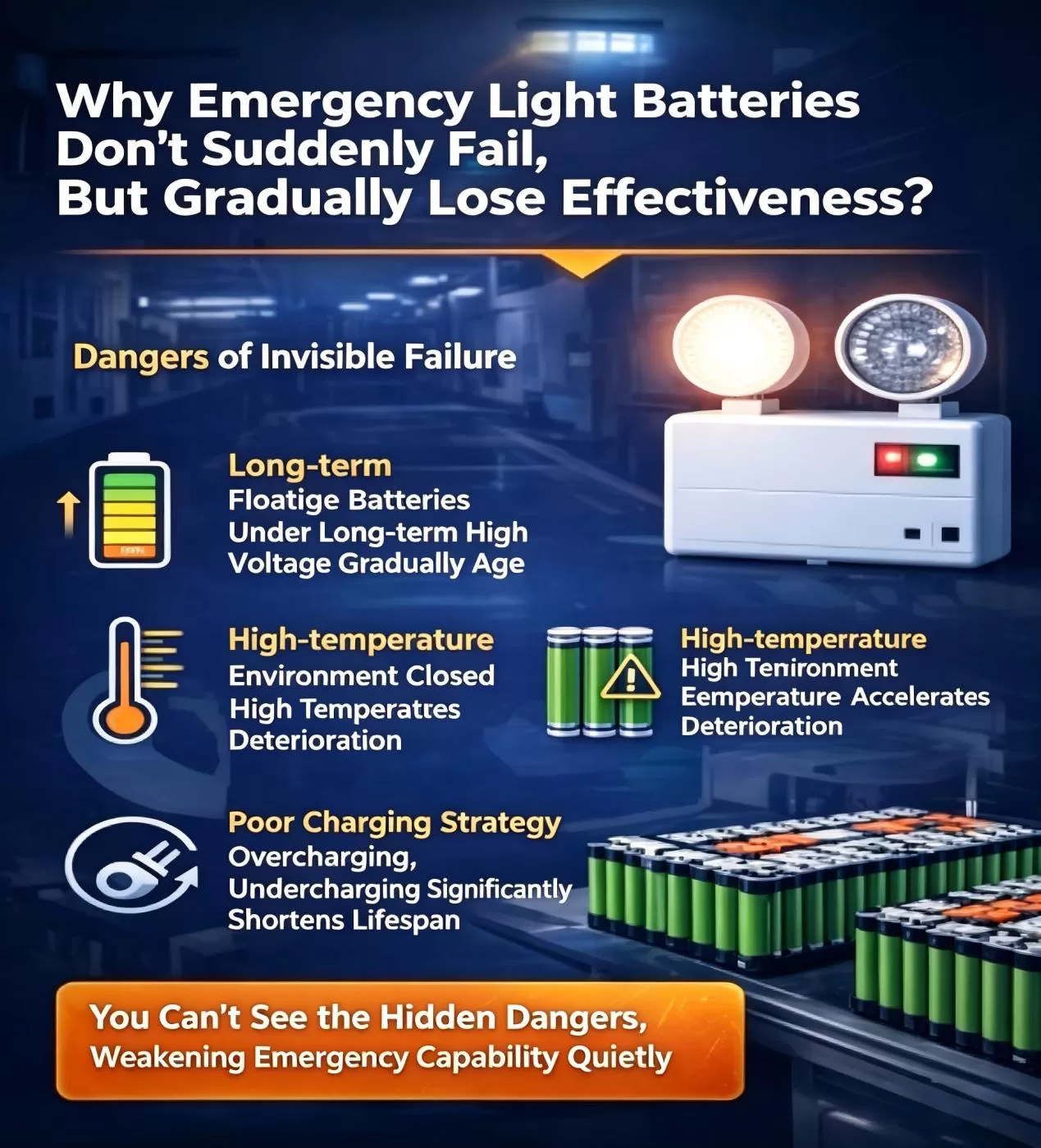
Second, ambient temperature is a major factor accelerating this hidden failure. Emergency lights are usually installed on ceilings, corridor tops, or inside equipment enclosures—locations with poor ventilation and high temperatures. Under long-term high temperatures, internal battery reactions speed up significantly, further accelerating the aging process. In many projects, even if batteries undergo almost no real discharge cycles, their service life is greatly shortened simply due to long-term exposure to high temperatures and float charging. This is why some emergency lights, even though “barely used,” fail to meet emergency duration requirements after one to two years of use.
Furthermore, consistency issues within battery packs are a seriously underestimated factor. Emergency light batteries usually consist of multiple cells. If just one cell performs poorly—with lower capacity or higher internal resistance—the discrepancy gradually widens over long-term use. This inconsistency causes imbalance during charging and discharging across the entire pack; some cells become overcharged, accelerating overall degradation. The final result is rapid performance decline of the whole pack, rather than obvious damage to a single cell. Such failure caused by internal imbalance is also gradual and difficult to detect in advance.
In addition, unreasonable charging strategies are another important cause. To reduce costs, some emergency light products use simple charging control methods, such as single constant-voltage charging without sophisticated management. Such schemes cannot dynamically adjust the charging process based on battery status, easily leading to severe long-term overcharging. Over time, this continuously damages battery capacity and lifespan, leaving it unable to deliver sufficient energy when critically needed.
Another often-overlooked factor is “calendar aging.” Even if a battery undergoes almost no discharge cycles and remains in float charge, internal materials naturally degrade over time due to prolonged float charging. This aging is less related to usage frequency and depends more on time, temperature, and overcharge level. Therefore, emergency light batteries do not maintain performance simply by staying in “standby state” for long periods.
Due to the combination of these factors, emergency light battery failures share a common characteristic: no obvious warning. Everything appears normal under daily use—indicator lights work, equipment functions properly—but problems only surface when power is actually needed. This “delayed exposure” leads users to believe the battery failed suddenly, when in reality it is the result of long-term accumulation.
To address these problems, solutions must start from both design and application. First, during the design phase, strategies should optimize the cell’s resistance to float charging, avoiding excessive long-term float charge or introducing stepped charging to slow overcharge-related aging. Second, high-consistency cells should be selected with strict sorting during production to ensure matched capacity and internal resistance, reducing imbalance risks from the source. Meanwhile, a more intelligent Battery Management System (BMS) should be adopted to continuously monitor voltage, temperature, and status, providing protection or balancing when necessary.
In terms of structure and application, thermal conditions should be improved as much as possible to avoid long-term high-temperature exposure, such as optimizing internal lamp structure or adding thermal design. In addition, it is recommended to add a regular discharge test mechanism at the system level—for example, short-duration discharge at intervals—to verify real battery capacity, rather than judging health solely by charging status.
From a usage and maintenance perspective, establishing regular inspection and replacement mechanisms is equally critical. Emergency light batteries should not be replaced only after failure; preventive replacement should be performed in advance based on service life or test data. Although this increases upfront costs, it effectively avoids greater risks from critical-point failure.