The Smart Pet Tracker (Pet GPS Locator) is a wearable IoT device that integrates multi-mode satellite positioning (GPS/Beidou/Glonass), wireless cellular communication (NB-IoT/LTE-M), and advanced motion sensors. Simply put, it serves as an "all-weather safety guardian" for pets on their wrists. In scenarios such as pets playing outdoors, traveling with owners, or getting lost due to sudden fright, the tracker helps prevent the distress of losing a beloved pet. By establishing electronic fences, tracking real-time movement paths, and monitoring health data, it precisely determines a pet's location, ensuring every outdoor outing is worry-free and providing an invisible yet essential safeguard for household pets.

The accuracy of a compact tracker's positioning, its battery life after loss of signal, and its safety when worn around the neck ultimately depend on the power source housed within its premium waterproof casing—the BPI high-performance lithium battery—which supplies energy to the entire IoT communication system.
In recent years, driven by the growing recognition of pets as integral members of households worldwide, the widespread adoption of anthropomorphic pet care practices, and breakthroughs in Low-Power Wide-Area Network (LPWAN) technology, pet trackers have evolved from traditional "short-range Bluetooth loss prevention devices" into comprehensive, long-distance, high-precision, and intelligent professional-grade equipment. Previously, conventional Bluetooth tags would completely lose contact beyond a few dozen meters, rendering them ineffective when pets were genuinely lost; whereas modern smart pet trackers, leveraging multi-mode positioning and base station assistance, can transmit location data in real time to owners' mobile apps even in remote areas such as deep mountains, basements, or wilderness regions. Pet trackers are no longer merely small anti-loss accessories but have become essential digital devices for ensuring pet safety.
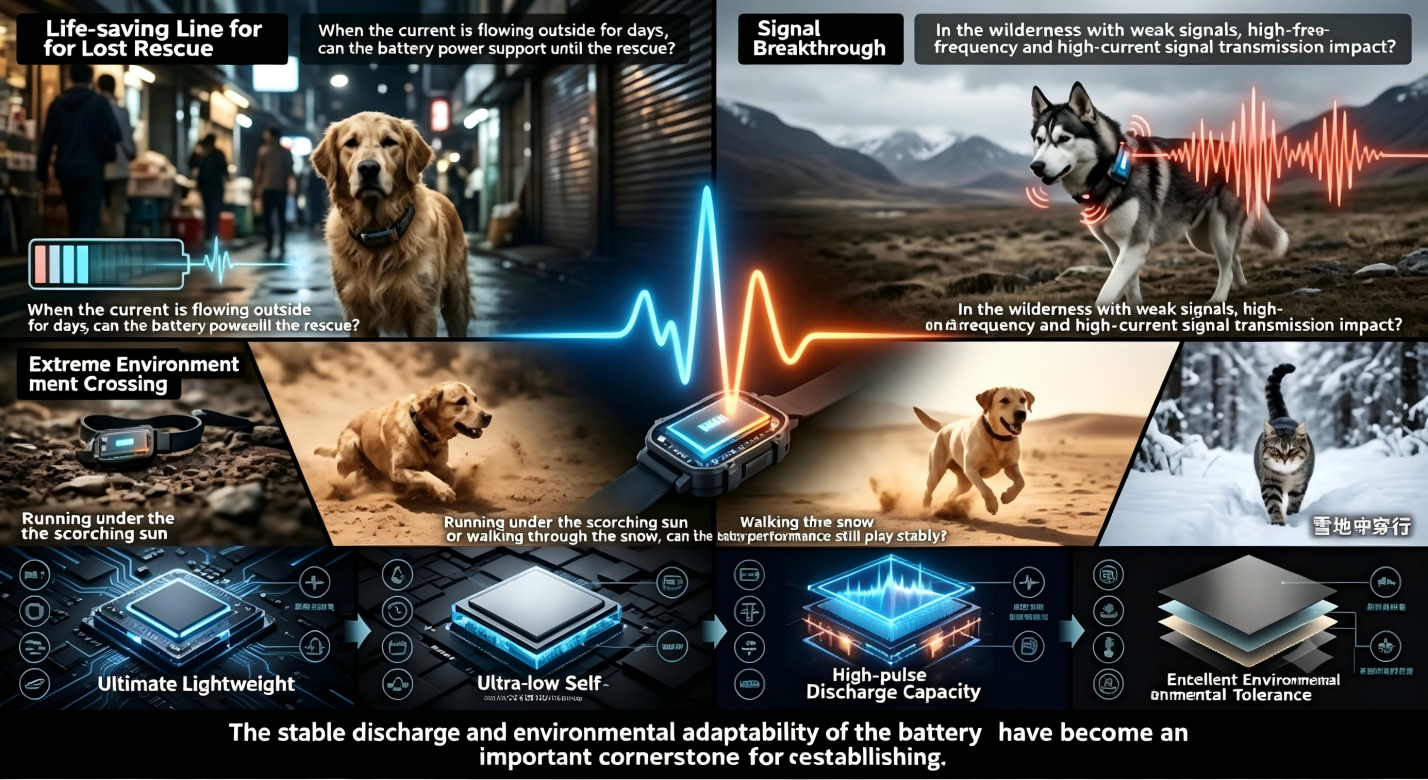
In this context, the power system is not merely the battery that sustains operation, but rather the "lifeline" for the entire rescue system in extreme situations. The key concerns for both the industry and pet owners are: when a pet gets lost and wanders for several consecutive days, can the battery capacity last until the owner finds it? When the device performs intensive signal searches in remote areas with weak signals, can the battery withstand the high-frequency, high-current transmission demands? And when the pet wears the device while running under scorching sunlight or traversing snowy terrain, does the battery performance remain stable and reliable?
This has directly driven the evolution of smart pet trackers' batteries toward achieving "extreme lightweight design, ultra-low self-discharge rates, superior pulse discharge performance, and exceptional environmental resilience." In these highly integrated, high-frequency interactive wearable devices, battery discharge stability and environmental adaptability have become critical foundations for establishing brand trust and user confidence.
Since pet trackers must be worn continuously by pets—especially small cats and dogs—their unique usage demands highly stringent, almost contradictory design requirements for the batteries.
Exquisite control of volume and weight (down to the gram): Devices worn around pets' necks must be as lightweight as possible, with the overall weight typically limited to within tens of grams to avoid compressing the cervical spine. This necessitates that batteries achieve maximum energy density within extremely confined spaces.
High instantaneous pulse current (signal transmission challenge): During sleep mode, the tracker's current remains at only microampere levels; however, when it is periodically awakened, initiates GPS positioning, and transmits location data to the base station via cellular networks (e.g., LTE/NB-IoT), the current surges instantly to hundreds of milliamps. The battery must exhibit excellent pulse discharge characteristics to prevent voltage spikes or system reset under high-pulse conditions.
All-weather outdoor environment tolerance: Pets inherently exhibit behaviors such as playing in water, digging in soil, and running in snow. Trackers are typically designed with full-sealed waterproof ratings of IP67 or IP68. The battery must maintain stable chemical activity under extreme conditions—including intense sunlight exposure during summer and extreme cold (-20°C or lower) during winter snow activities.
Excellence in ultra-low self-discharge (extremely long battery life): Many pet owners may only activate the tracker when taking their pets outdoors on weekends, leaving it dormant during regular periods. The battery must exhibit an exceptionally low self-discharge rate to ensure sufficient power remains available for emergency use, while providing several weeks or even months of operation in low-frequency positioning mode.
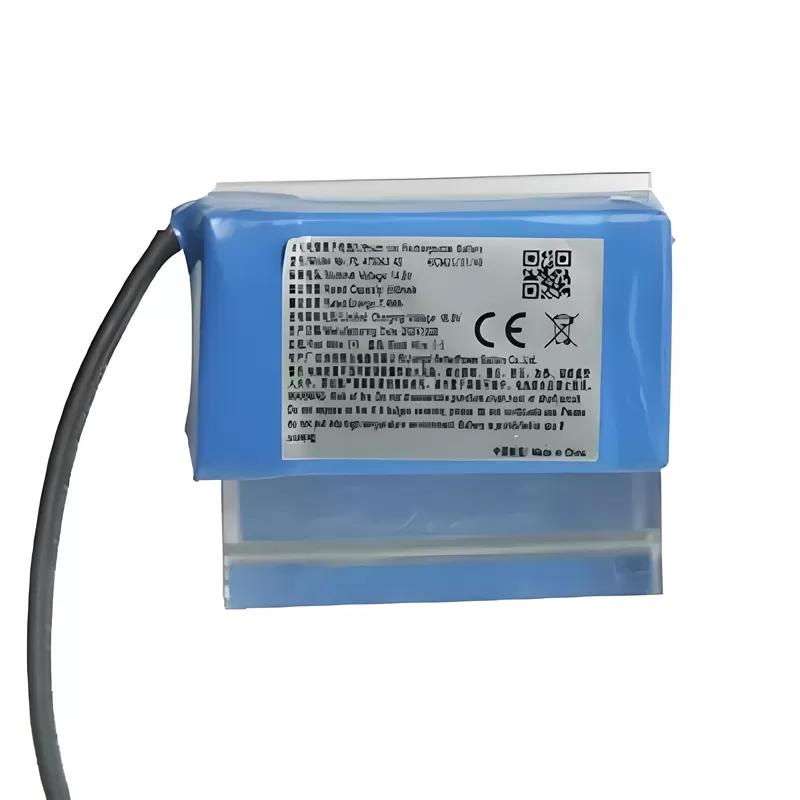
Among various battery technologies, high-performance lithium-ion batteries—particularly lithium polymer soft-pack batteries—have become the standard choice for smart pet trackers due to their customizable form factor, high specific energy, and excellent pulse discharge performance.
Core Requirements | The solution for BPI's lithium-ion batteries |
Extremely thin, lightweight, and portable | The lithium polymer soft-pack technology features high energy density and allows for the production of ultra-thin cells in various sizes tailored to the tracker housing. |
Strong pulse support | Specifically optimized for IoT communication, this dynamic design supports high-rate instantaneous pulse discharge, ensuring successful transmission of positioning data over cellular networks even under weak signal conditions. |
Unafraid of the severe cold of winter and summer | Using a wide-temperature electrolyte formulation, the battery maintains low internal resistance even at low temperatures, effectively preventing loss of contact due to battery "freezing" during outdoor activities in winter. |
Intelligent Low-power Management | Combined with a low-power BMS (Battery Management System), it exhibits minimal self-discharge and significantly extends the critical search window in smart power-saving mode. |
Worn close to the body, safety takes precedence above all else. The BPI battery has obtained globally recognized safety certifications including UN38.3, IEC62133, and colloid leak-proof tests. To withstand potential physical impacts such as collisions or bites from pets, the battery features structural and material enhancements for puncture and compression resistance, ensuring no thermal runaway under extreme impact conditions and providing comprehensive protection for your beloved pets.
As a manufacturing company with decades of expertise in the battery industry, BPI boasts robust technical capabilities in developing high-performance, long-lasting, and highly safe consumer-grade and industrial-grade lithium polymer manufacturers.
To address two major industry challenges faced by smart pet trackers—extremely limited spatial coverage and weak signal with high-pulse emissions—BPI has introduced a battery solution specifically optimized for pet wearable IoT devices.
In terms of form customization, BPI boasts an advanced micro-scale cell manufacturing process that allows precise tailoring to the internal space requirements of tracker manufacturers. This enables hardware engineers to optimize device specifications without compromising on battery size, thereby accommodating more advanced antennas and sensors within the equipment.
In terms of electrochemical performance, BPI incorporates nanoscale conductive agents and a low internal resistance tab design. This enables the cell to effectively handle instantaneous high pulse currents during network tracking at both ambient temperature and extreme cold conditions (-20°C), significantly preventing "false shutdown" caused by transient voltage drops. Additionally, through rigorous material selection and process control, its monthly self-discharge rate is maintained at an extremely low level, greatly extending the tracker's "golden rescue window" in field applications.
1. Misconception 1: Focusing solely on nominal capacity while ignoring pulse voltage drop (which can cause sudden disconnection when the device goes missing). Many manufacturers determine the required capacity based solely on standby current and use standard low-rate digital batteries. When a pet gets lost in areas with poor signal coverage, such as forests or underground, the device increases its transmission power to connect to the base station, causing an instantaneous surge in current. If the battery's pulse capacity is insufficient at this point, the voltage may plummet below the reset threshold of the main control chip, leading to immediate device shutdown. The owner will only see "Device offline" on their phone, missing the optimal window for tracking.
2. Misconception 2: Underestimating the impact of environmental temperature fluctuations on outdoor equipment. Pet trackers are designed as all-weather outdoor devices. If standard lithium batteries not optimized for wide temperature ranges are used, their internal resistance increases significantly in northern regions during winter, causing a battery life that could normally last 10 days to be depleted within just two hours. This can prove fatal for lost pets in cold winter environments.
In the ever-changing world of outdoor adventures or daily life, the components that truly earn their owners 'trust often lie hidden deep within the device's casing. While the tracker's positioning algorithm and smartphone app interface are visually appealing, it is the lithium battery in the collar—quietly delivering reliable power through wind, rain, extreme cold, and high-frequency communication—that serves as the cornerstone of the "last unbreakable bond" between owner and pet.
The BPI lithium battery continues to deliver exceptional value in these critical yet often overlooked yet life-critical areas through its outstanding performance characteristics: stability, reliability, lightweight design, high energy density, and inherent safety. It empowers trackers to operate effectively under harsh environmental conditions, with weak signals, and during prolonged deployment periods, while stringent quality control ensures that safety mechanisms never fail when required.
In the application of smart pet hardware and wearable devices, battery quality directly determines the safety of your pets' lives. BPI consistently adheres to stringent manufacturing and quality control standards, with full-process traceability ensuring every battery cell provides reliable protection at every stage of monitoring and care.
For smart pet trackers, choose precision, reliability – and BPI!
Q: Can BPI accommodate customized small batteries of various sizes required for pet trackers?
A: Supported. We offer ultra-thin flexible packaging and customized lithium batteries in various sizes to accommodate different ergonomic enclosures such as tracker collars and pendants, maximizing internal space utilization.
Q: What are the technical advantages of BPI's batteries in supporting high-rate discharge applications for IoT devices such as NB-IoT/LTE-M?
A: Our battery cells employ a highly conductive electrolyte system and a specialized electrode coating process to minimize the internal impedance (IR) significantly. When subjected to instantaneous RF emission pulses of 1 A–2 A from IoT modules, they maintain stable discharge performance and prevent device restarts caused by low-voltage protection mechanisms.
Q: Does the product hold the necessary certifications required for success in overseas pet markets such as those in Europe and America?
A: Yes. All BPI lithium battery product lines comply with global leading safety and environmental certifications including UN38.3, UL, CE, ROHS, REACH, PSE, and KC, and are manufactured in strict adherence to advanced quality management standards, enabling customers' brands to successfully expand internationally without concerns.