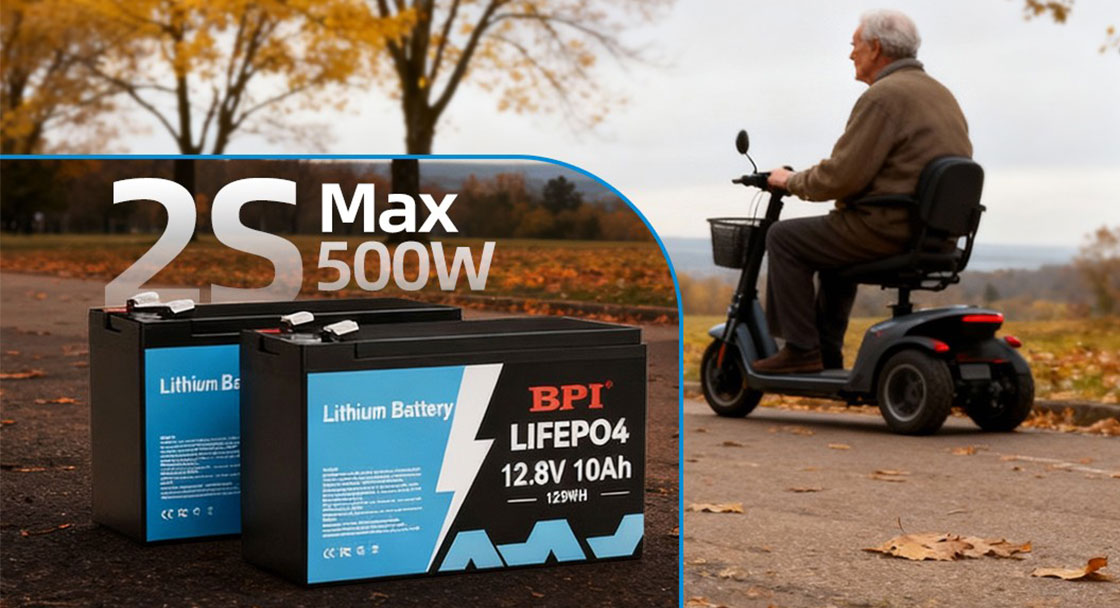
Electric wheelchairs provide a convenient means of mobility for people with mobility impairments and are widely used both indoors and outdoors. Their built-in lithium battery packs (commonly using 18650, 21700, or 32600 battery combinations) can be fully charged quickly, ensuring they are always ready for use and meeting users' flexible travel needs; they also guarantee a long battery life; and they are equipped with an intelligent control system, allowing users to easily control the wheelchair's forward, backward, and turning movements using a joystick or other control devices. These features make electric wheelchairs an important device for improving the quality of life for people with mobility impairments.
Shenzhen Better Power Battery Co., Ltd. combines advanced manufacturing, cutting-edge R&D, and strict quality control to deliver high-performance battery solutions. With state-of-the-art facilities, international certifications (ISO, UL, CE, RoHS), and a focus on customization, we meet the diverse needs of global industries.
| Battery Type | Model | Size(mm) | Voltage(v) | Capacity(mAh) | IEC lifespan(cycles) | Initial internal resistance(mΩ) | Configuration Method |
| Li-ion | 24V 20Ah | 235*193*115 | 24 | 20 | 1500 | ≤100 | 10S1P |
| Pack | 48V 52Ah | 315*275*145 | 48 | 52 | 3000 | ≤180 | 15S1P |
| Customized on demand | |||||||
The correct battery voltage depends on the complete wheelchair electrical system. A replacement should not be selected only by matching the voltage or amp-hour value printed on the original battery.
A 12 volt wheelchair battery may be used individually in certain mobility devices or combined with another battery in equipment designed around a higher system voltage.
Common replacement inquiries include:
12V 35Ah wheelchair battery
12V 35Ah U1 wheelchair battery
12V 50Ah wheelchair battery
12V 55Ah wheelchair battery
22NF wheelchair battery
A buyer searching for a 12 volt 35 amp wheelchair battery should also confirm the physical case size, terminal position, chemistry, charger and discharge current. Batteries with the same 12V 35Ah rating may still differ in dimensions, terminal layout and load capability.
For a 12V wheelchair battery replacement project, please provide the original battery label, case dimensions, terminal photos, charger output and wheelchair model.
BPI can evaluate a custom 12V solution through its 12V LiFePO4 battery platform, subject to complete-system compatibility.
U1 and 22NF generally describe battery case formats rather than complete compatibility specifications.
A request for a 12V 35Ah U1 wheelchair battery should include:
Maximum case length, width and height
Positive and negative terminal positions
Terminal type
Required continuous current
Peak motor current
Original charger specifications
Available mounting method
The same applies when replacing a 22NF battery for wheelchair equipment. The original dimensions and electrical requirements should be checked before selecting or developing a replacement.
A 24V wheelchair battery can be developed as one integrated battery pack or as part of a wheelchair power system designed around a nominal 24V platform.
A custom 24 volt wheelchair battery may provide a more integrated solution than two separate 12V units, but the controller, charger, low-voltage warning, connector and installation structure must all be matched to the new battery design.
BPI can evaluate a 24V LiFePO4 battery for powered mobility applications. A 24V lithium wheelchair battery can be customized by:
Rated capacity
Continuous discharge current
Peak discharge current
BMS protection settings
Enclosure dimensions
Connector and cable design
Charging interface
State-of-charge display
Communication requirements
Lithium and lead-acid batteries differ in weight, charging, maintenance, usable energy and integration requirements.
A traditional deep cycle battery for wheelchair equipment may use AGM, gel or flooded lead-acid chemistry. A custom lithium replacement should be treated as a system-conversion project rather than a direct voltage-only substitution.
| Comparison | Lithium Wheelchair Battery | Deep-Cycle Lead-Acid Battery |
| Weight | Generally lower at comparable usable energy | Generally heavier |
| Battery management | Normally uses a BMS | Usually does not use a lithium-style BMS |
| Charging | Requires a compatible lithium profile | Requires a matching lead-acid profile |
| Maintenance | Normally sealed and maintenance-free | Depends on battery type |
| Voltage profile | Relatively stable during discharge | Voltage generally decreases during discharge |
| Custom dimensions | Flexible pack configuration | Usually follows standardized cases |
| Replacement requirements | Charger and controller must be verified | Often matches the original equipment design |
| Initial cost | Commonly higher | Commonly lower |
A deep cycle wheelchair battery should not automatically be replaced with lithium without checking:
Maximum charging voltage
Charger output profile
Continuous and peak motor current
Low-voltage cutoff
State-of-charge indication
Battery dimensions
Terminal and connector configuration
Wheelchair controller requirements
A wheelchair wet cell battery may also require different maintenance and installation considerations from sealed or lithium systems.
Wheelchair battery sizes include more than external length, width and height. Buyers must also consider voltage, capacity, energy, current capability, terminals and charging requirements.
Before requesting a quotation, provide the following information:
| Required Information | Why It Matters |
| Wheelchair brand and model | Identifies the equipment platform |
| New development or replacement | Determines the project route |
| Original battery chemistry | Supports chemistry selection |
| Nominal voltage | Defines the system voltage |
| Rated capacity | Provides an energy reference |
| Maximum charging voltage | Determines charger compatibility |
| Continuous current | Supports routine operation |
| Peak current and duration | Supports startup and climbing loads |
| Motor power | Helps evaluate power demand |
| Required travel range | Supports energy calculation |
| Battery compartment dimensions | Defines pack size |
| Maximum battery weight | Supports mobility and handling |
| Terminal or connector | Ensures electrical compatibility |
| Charger label and output | Verifies charging requirements |
| Removable or fixed design | Determines enclosure structure |
| Estimated annual quantity | Supports sample and production planning |
For a wheelchair battery replacement, include clear photographs of the original battery label, terminals, connector, charger and battery compartment.
A BMS monitors and controls a lithium wheelchair power pack within its specified voltage, current and temperature limits.
BPI’s BMS customization services can support configurable functions such as:
Overcharge protection
Over-discharge protection
Overcurrent protection
Short-circuit protection
Temperature monitoring
Cell balancing
State-of-charge display
Current detection
Fault recording
Cycle monitoring
Charging management
Custom communication functions
BPI’s official BMS service page lists customizable communication protocols, SOC display, current detection, fault records, cycle monitoring and multiple charging and discharging protections. The final BMS settings should be developed around the wheelchair motor current, charger, controller and operating conditions.
Electric wheelchairs may use AGM, gel, wet-cell lead-acid, lithium-ion or LiFePO4 batteries. The correct chemistry depends on the wheelchair controller, charger, current load, battery compartment and original equipment design.
Some equipment uses individual 12V batteries, while many powered wheelchairs operate on a higher system voltage. A 24V wheelchair battery may be an integrated pack or a system assembled from compatible batteries. Always verify the original wheelchair specifications.
Only when the larger battery meets the available dimensions, terminal layout, charger requirements, permitted weight and current specifications. A 12V 50Ah wheelchair battery or 12V 55Ah wheelchair battery should not be selected from capacity alone.
U1 and 22NF refer mainly to different physical case formats. A 22NF wheelchair battery is normally larger than a U1-format battery, but the exact dimensions, terminals and electrical requirements must be confirmed from the original equipment.
Yes, a lithium replacement can be evaluated, but the charger, controller, low-voltage cutoff, current requirements, connectors, installation space and state-of-charge indication must be verified.
It may. The original charger should only be used when its charging voltage, profile and cutoff behavior are fully compatible with the new battery and BMS.
Wheelchair battery cost depends on chemistry, voltage, capacity, current, BMS, enclosure, connector, testing requirements and order quantity. A customized quotation requires the original battery and wheelchair specifications.
Not automatically. A battery for wheelchair scooter equipment or a battery for scooter chair must match the exact voltage, charger, current, dimensions and connector of the intended device.
Buyers comparing wheelchair batteries for sale should check compatibility, usable energy, discharge current, charger requirements, dimensions, weight, warranty and technical documentation—not only the advertised capacity or price.
Provide the wheelchair model, battery label, voltage, capacity, dimensions, motor power, continuous and peak current, charger details, connector, required range and annual quantity.
| Battery Type | Model | Size(mm) | Voltage(v) | Capacity(mAh) | IEC lifespan(cycles) | Initial internal resistance(mΩ) | Configuration Method |
| Li-ion | 24V 20Ah | 235*193*115 | 24 | 20 | 1500 | ≤100 | 10S1P |
| Pack | 48V 52Ah | 315*275*145 | 48 | 52 | 3000 | ≤180 | 15S1P |
| Customized on demand | |||||||
The correct battery voltage depends on the complete wheelchair electrical system. A replacement should not be selected only by matching the voltage or amp-hour value printed on the original battery.
A 12 volt wheelchair battery may be used individually in certain mobility devices or combined with another battery in equipment designed around a higher system voltage.
Common replacement inquiries include:
12V 35Ah wheelchair battery
12V 35Ah U1 wheelchair battery
12V 50Ah wheelchair battery
12V 55Ah wheelchair battery
22NF wheelchair battery
A buyer searching for a 12 volt 35 amp wheelchair battery should also confirm the physical case size, terminal position, chemistry, charger and discharge current. Batteries with the same 12V 35Ah rating may still differ in dimensions, terminal layout and load capability.
For a 12V wheelchair battery replacement project, please provide the original battery label, case dimensions, terminal photos, charger output and wheelchair model.
BPI can evaluate a custom 12V solution through its 12V LiFePO4 battery platform, subject to complete-system compatibility.
U1 and 22NF generally describe battery case formats rather than complete compatibility specifications.
A request for a 12V 35Ah U1 wheelchair battery should include:
Maximum case length, width and height
Positive and negative terminal positions
Terminal type
Required continuous current
Peak motor current
Original charger specifications
Available mounting method
The same applies when replacing a 22NF battery for wheelchair equipment. The original dimensions and electrical requirements should be checked before selecting or developing a replacement.
A 24V wheelchair battery can be developed as one integrated battery pack or as part of a wheelchair power system designed around a nominal 24V platform.
A custom 24 volt wheelchair battery may provide a more integrated solution than two separate 12V units, but the controller, charger, low-voltage warning, connector and installation structure must all be matched to the new battery design.
BPI can evaluate a 24V LiFePO4 battery for powered mobility applications. A 24V lithium wheelchair battery can be customized by:
Rated capacity
Continuous discharge current
Peak discharge current
BMS protection settings
Enclosure dimensions
Connector and cable design
Charging interface
State-of-charge display
Communication requirements
Lithium and lead-acid batteries differ in weight, charging, maintenance, usable energy and integration requirements.
A traditional deep cycle battery for wheelchair equipment may use AGM, gel or flooded lead-acid chemistry. A custom lithium replacement should be treated as a system-conversion project rather than a direct voltage-only substitution.
| Comparison | Lithium Wheelchair Battery | Deep-Cycle Lead-Acid Battery |
| Weight | Generally lower at comparable usable energy | Generally heavier |
| Battery management | Normally uses a BMS | Usually does not use a lithium-style BMS |
| Charging | Requires a compatible lithium profile | Requires a matching lead-acid profile |
| Maintenance | Normally sealed and maintenance-free | Depends on battery type |
| Voltage profile | Relatively stable during discharge | Voltage generally decreases during discharge |
| Custom dimensions | Flexible pack configuration | Usually follows standardized cases |
| Replacement requirements | Charger and controller must be verified | Often matches the original equipment design |
| Initial cost | Commonly higher | Commonly lower |
A deep cycle wheelchair battery should not automatically be replaced with lithium without checking:
Maximum charging voltage
Charger output profile
Continuous and peak motor current
Low-voltage cutoff
State-of-charge indication
Battery dimensions
Terminal and connector configuration
Wheelchair controller requirements
A wheelchair wet cell battery may also require different maintenance and installation considerations from sealed or lithium systems.
Wheelchair battery sizes include more than external length, width and height. Buyers must also consider voltage, capacity, energy, current capability, terminals and charging requirements.
Before requesting a quotation, provide the following information:
| Required Information | Why It Matters |
| Wheelchair brand and model | Identifies the equipment platform |
| New development or replacement | Determines the project route |
| Original battery chemistry | Supports chemistry selection |
| Nominal voltage | Defines the system voltage |
| Rated capacity | Provides an energy reference |
| Maximum charging voltage | Determines charger compatibility |
| Continuous current | Supports routine operation |
| Peak current and duration | Supports startup and climbing loads |
| Motor power | Helps evaluate power demand |
| Required travel range | Supports energy calculation |
| Battery compartment dimensions | Defines pack size |
| Maximum battery weight | Supports mobility and handling |
| Terminal or connector | Ensures electrical compatibility |
| Charger label and output | Verifies charging requirements |
| Removable or fixed design | Determines enclosure structure |
| Estimated annual quantity | Supports sample and production planning |
For a wheelchair battery replacement, include clear photographs of the original battery label, terminals, connector, charger and battery compartment.
A BMS monitors and controls a lithium wheelchair power pack within its specified voltage, current and temperature limits.
BPI’s BMS customization services can support configurable functions such as:
Overcharge protection
Over-discharge protection
Overcurrent protection
Short-circuit protection
Temperature monitoring
Cell balancing
State-of-charge display
Current detection
Fault recording
Cycle monitoring
Charging management
Custom communication functions
BPI’s official BMS service page lists customizable communication protocols, SOC display, current detection, fault records, cycle monitoring and multiple charging and discharging protections. The final BMS settings should be developed around the wheelchair motor current, charger, controller and operating conditions.
Electric wheelchairs may use AGM, gel, wet-cell lead-acid, lithium-ion or LiFePO4 batteries. The correct chemistry depends on the wheelchair controller, charger, current load, battery compartment and original equipment design.
Some equipment uses individual 12V batteries, while many powered wheelchairs operate on a higher system voltage. A 24V wheelchair battery may be an integrated pack or a system assembled from compatible batteries. Always verify the original wheelchair specifications.
Only when the larger battery meets the available dimensions, terminal layout, charger requirements, permitted weight and current specifications. A 12V 50Ah wheelchair battery or 12V 55Ah wheelchair battery should not be selected from capacity alone.
U1 and 22NF refer mainly to different physical case formats. A 22NF wheelchair battery is normally larger than a U1-format battery, but the exact dimensions, terminals and electrical requirements must be confirmed from the original equipment.
Yes, a lithium replacement can be evaluated, but the charger, controller, low-voltage cutoff, current requirements, connectors, installation space and state-of-charge indication must be verified.
It may. The original charger should only be used when its charging voltage, profile and cutoff behavior are fully compatible with the new battery and BMS.
Wheelchair battery cost depends on chemistry, voltage, capacity, current, BMS, enclosure, connector, testing requirements and order quantity. A customized quotation requires the original battery and wheelchair specifications.
Not automatically. A battery for wheelchair scooter equipment or a battery for scooter chair must match the exact voltage, charger, current, dimensions and connector of the intended device.
Buyers comparing wheelchair batteries for sale should check compatibility, usable energy, discharge current, charger requirements, dimensions, weight, warranty and technical documentation—not only the advertised capacity or price.
Provide the wheelchair model, battery label, voltage, capacity, dimensions, motor power, continuous and peak current, charger details, connector, required range and annual quantity.


Shenzhen Better Power Battery Co., Ltd. combines advanced manufacturing, cutting-edge R&D, and strict quality control to deliver high-performance battery solutions. With state-of-the-art facilities, international certifications (ISO, UL, CE, RoHS), and a focus on customization, we meet the diverse needs of global industries.

Better Power has four major battery materials research laboratories and collaborates with top universities.

We specialize in providing fully customized battery solutions, from cell design to final integration.

Our state-of-the-art facilities in Shenzhen and Jiangxi ensure consistent quality and large-scale production capabilities.

We use eco-friendly materials and manufacturing processes, adhering to RoHS standards.