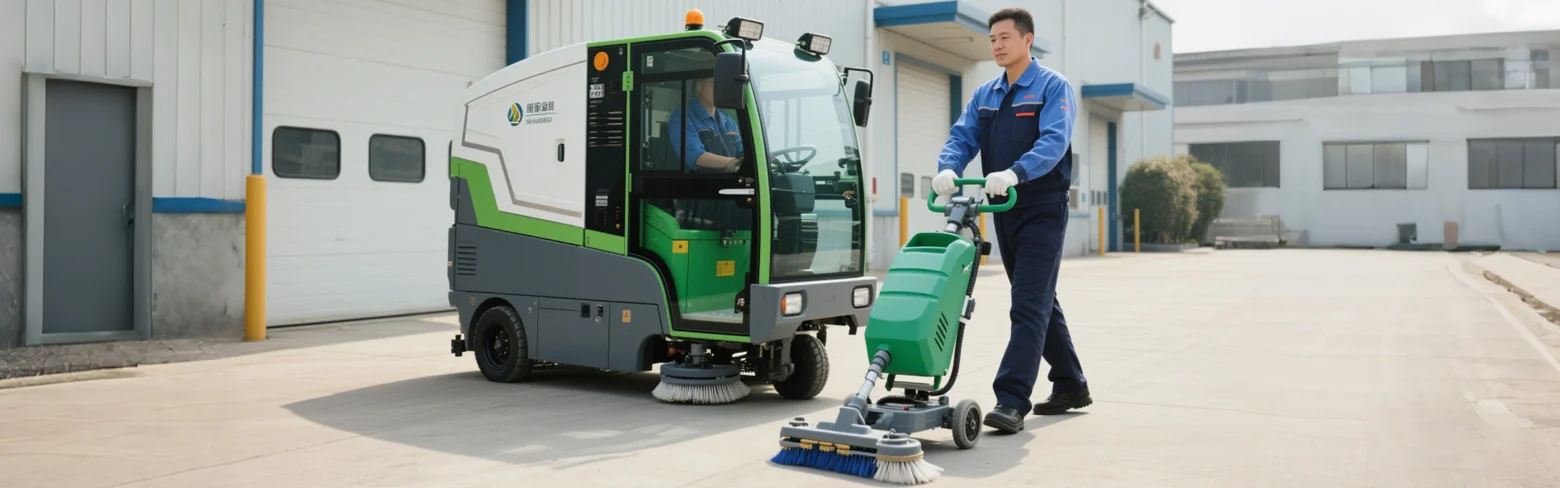
Industrial cleaning vehicles, such as ride-on sweepers and scrubbers, are essential for maintaining cleanliness in large-scale environments like factories, airports, warehouses, and shopping malls. With the shift toward eco-friendly and efficient operations, many of these machines now use battery-powered systems instead of traditional fuel engines. These rechargeable battery systems offer quiet, emission-free performance while enhancing mobility and reducing operational costs.
Equipped with lithium-ion or lead-acid batteries, these vehicles provide 4 to 8+ hours of continuous use per charge, ideal for long cleaning shifts.
Battery power enables clean, fume-free performance, making these machines suitable for indoor or sensitive environments.
Many models support fast charging or opportunity charging—allowing the battery to be topped up during breaks to maximize uptime.
Digital dashboards display real-time battery levels, charge status, and estimated runtime, helping operators manage usage efficiently.
Batteries reduce the risk of fuel spills, noise hazards, and complex mechanical maintenance, improving both operator safety and machine lifespan.
Some models offer interchangeable batteries, allowing for non-stop operation in high-demand industrial settings.
Shenzhen Better Power Battery Co., Ltd. combines advanced manufacturing, cutting-edge R&D, and strict quality control to deliver high-performance battery solutions. With state-of-the-art facilities, international certifications (ISO, UL, CE, RoHS), and a focus on customization, we meet the diverse needs of global industries.
| Battery Type | Model | Size(mm) | Voltage(v) | Capacity(Ah) | IEC lifespan(cycles) | Initial internal resistance(mΩ) | Configuration Method |
| LFP | 25.6V 80Ah | customized | 25.6 | 80 | 2000 | ≤60 | 8S1P |
| Customized on demand | |||||||
Selecting a battery requires matching its electrical, mechanical and charging characteristics to the complete cleaning machine.
For buyers comparing floor scrubber batteries for sale, the decision should not be based only on voltage, capacity or purchase price. A lower-priced pack may not be suitable if its discharge current, dimensions, charging profile, connector or BMS settings do not match the machine.
The following information should be submitted before battery development or quotation:
| Information Required | Why It Is Needed |
| Cleaning machine brand and model | Identifies the equipment platform |
| Machine operating voltage | Determines the battery voltage |
| Original battery chemistry | Defines the replacement strategy |
| Original battery capacity | Provides an initial energy reference |
| Average operating current | Supports runtime calculation |
| Peak current and duration | Determines cells and BMS settings |
| Required operating time | Determines the target energy capacity |
| Battery compartment dimensions | Defines enclosure size |
| Maximum battery weight | Supports equipment balance |
| Charger model and output | Confirms charging compatibility |
| Connector and pin definition | Ensures correct installation |
| Cable length and wire gauge | Supports current and layout requirements |
| Working temperature | Influences cells and protection settings |
| Water and dust exposure | Defines enclosure and sealing needs |
| Communication requirements | Determines BMS interface functions |
| Estimated annual volume | Supports sampling and production planning |
LiFePO4 and lead-acid batteries use different charging methods, protection systems and discharge characteristics. A lithium conversion should therefore be evaluated as an equipment-integration project rather than a simple voltage-matched replacement.
| Comparison | LiFePO4 Battery | Lead-Acid Battery |
| Routine maintenance | Does not require electrolyte watering | Flooded types may require watering |
| Battery management | Normally uses a BMS | Usually does not use a lithium-style BMS |
| Weight | Typically lower at comparable usable energy | Typically heavier |
| Voltage profile | Relatively stable during discharge | Voltage gradually decreases during discharge |
| Opportunity charging | Can be designed with a compatible system | Depends on battery type and charger |
| Charger | Requires a compatible lithium profile | Requires a matching lead-acid profile |
| Initial investment | Usually higher | Usually lower |
| Replacement design | Charger and interface verification required | Existing equipment may already be configured |
| Custom monitoring | SOC and communication can be integrated | Depends on the equipment system |
BPI’s LiFePO4 battery range includes 24V and 48V platforms, and its 48V product page specifically identifies floor scrubbers as a potential application. Final compatibility must still be confirmed for each machine.
A battery management system monitors and controls the battery within its defined voltage, current and temperature limits.
Through custom BMS development, BPI can evaluate functions such as:
Overcharge protection
Over-discharge protection
Overcurrent protection
Short-circuit protection
High- and low-temperature protection
Cell balancing
Current detection
State-of-charge display
Fault recording
Cycle monitoring
Charging control
Communication functions
BPI’s BMS customization page lists configurable communication, SOC display, current detection, fault recording, charging protection and temperature-control functions. The functions included in the final design should be confirmed according to the machine controller and project requirements.
Where required, BPI can evaluate communication interfaces such as RS485, CAN, UART or another protocol specified by the equipment manufacturer. Protocol availability should be confirmed before the page lists a particular interface as standard.
Floor scrubbers may use flooded lead-acid, AGM, gel or LiFePO4 batteries. The correct battery depends on the machine voltage, load current, charger, installation space and operating schedule.
Capacity should be calculated from the average machine power and required runtime, with additional allowance for peak loads, conversion losses, temperature and long-term capacity reduction.
Runtime depends on usable battery energy, cleaning mode, drive speed, suction load, brush pressure, floor conditions and battery condition. There is no single runtime that applies to every machine.
Not necessarily. Auto scrubbers and sweepers may use different voltage systems, current loads, battery compartments, connectors and chargers. Compatibility must be evaluated for the specific machine.
A LiFePO4 conversion can be developed after confirming the charger, current requirements, BMS, physical dimensions, connectors and machine-control logic.
It may. The existing charger can only be retained when its voltage, charging profile and cutoff behavior are compatible with the LiFePO4 battery and BMS.
Yes. Connector model, pin definition, cable length, enclosure size, mounting points and charging port can be developed according to the equipment layout.
Please provide the machine model, original battery label, voltage, capacity, load current, required runtime, dimensions, charger information, connector photos and estimated purchase quantity.


Shenzhen Better Power Battery Co., Ltd. combines advanced manufacturing, cutting-edge R&D, and strict quality control to deliver high-performance battery solutions. With state-of-the-art facilities, international certifications (ISO, UL, CE, RoHS), and a focus on customization, we meet the diverse needs of global industries.

Better Power has four major battery materials research laboratories and collaborates with top universities.

We specialize in providing fully customized battery solutions, from cell design to final integration.

Our state-of-the-art facilities in Shenzhen and Jiangxi ensure consistent quality and large-scale production capabilities.

We use eco-friendly materials and manufacturing processes, adhering to RoHS standards.